
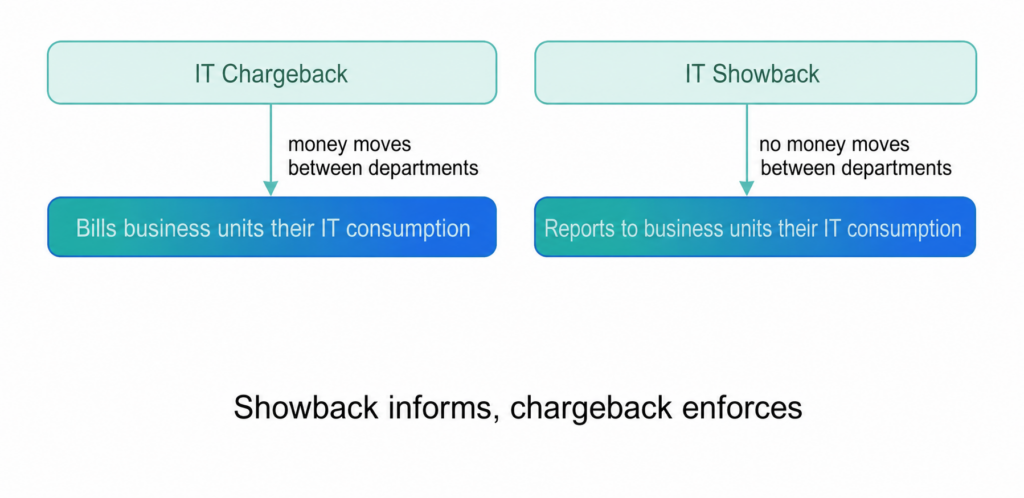
IT chargeback and showback are two different ways to manage IT spending inside an organization. Chargeback bills a business unit for what it actually consumes, while showback simply reports that same consumption, with no bill attached. Both are part of the wider discipline of IT Financial Management (ITFM).
This page covers what each one is, when to use which, the profit-and-loss problem chargeback creates inside IT, and what you need in place before implementing either.
Key Takeaways
- Chargeback bills business units for their IT consumption, while showback reports the same consumption without billing for it.
- Most enterprises start with showback to build trust in the model, then move individual services to chargeback once volume data is reliable.
- Both models depend on a defined service catalog, a measurable unit for each service, and a cost model that produces a defensible price.
What is IT Chargeback?
IT chargeback is a cost allocation model in which the IT department bills internal business units for the IT products and services they consume. Each service has a price, and price times consumed volume is transferred to the consuming department’s budget, making business units financially accountable for their IT usage.
In practice, chargeback means treating IT like an internal supplier. IT defines its products and services, calculates a cost price for each, measures consumption per business unit, and issues an internal bill of IT. Because money actually moves between budgets, chargeback gives you the strongest form of accountability available. Departments that pay for their IT consumption tend to manage it.
There is one important difference from a real business: business units usually cannot buy their IT services elsewhere, so IT is the only supplier in its internal market. That is why the profit or loss chargeback creates inside IT needs a deliberate decision attached to it (more on that below).
Advantages of IT Chargeback
Here are the main benefits of implementing IT chargeback:
- Financial accountability: Showback creates awareness but chargeback creates accountability because the cost actually lands on someone’s budget so someone has to answer for it.
- Demand gets shaped: When consumption costs a department money, it changes. A detailed bill of IT lets business managers see the cost consequences of their decisions (e.g., extra licenses, storage, or environments) before committing to them.
- Integral cost prices become possible: If you want to know the true cost of a bank account, a credit card, or a claim, IT cost cannot sit stranded in a central department. Chargeback pushes every cost out to the products and units that consume it.
- Full cost recovery: IT’s costs are recovered directly from the departments that cause them, in proportion to what each one actually consumes.
- Budget conversations move to volumes: Instead of arguing about a lump sum, IT and the business can discuss how many licenses, storage, and compute a business initiative actually needs.
Disadvantages of IT Chargeback
Here are the main disadvantages of implementing IT chargeback:
- Internal friction and disputes: IT chargeback generates disputes when the model is not trusted. People need to believe the allocation logic before they will accept an invoice based on it. If they do not, chargeback creates internal friction instead of accountability.
- Tariff instability frustrates departments: If prices change during the year, departments can no longer manage their own budgets. This is the single biggest practical objection to chargeback, and it’s covered in detail below.
- IT ends up with a profit or loss: Recovery rarely matches cost exactly, so you have to decide in advance what happens to the difference.
- Administrative overhead: Chargeback requires accurate pricing, volume measurement, invoicing, and regular true-ups against budgets, all integrated with existing financial systems.
What is IT Showback?
IT showback is a cost reporting model in which the IT department shows business units the cost of the IT resources they consume without actually billing them. The mechanics are identical to chargeback (products, prices, measured volumes), but no money moves between departments. The goal of IT showback is cost awareness and visibility rather than cost recovery.
Showback is effectively a chargeback without the invoice. Business units receive the same detailed view of their consumption and its cost, which builds awareness first and a degree of accountability second. Because budgets are not affected, showback avoids most of the political friction of chargeback, which is why most enterprises use it as their starting point.
Advantages of IT Showback
The advantages of IT showback are:
- Creates awareness without conflict: Showing departments what their consumption costs gives them time to trust the model and adjust behaviour voluntarily.
- Simple to implement: No invoicing, true-ups, or changes to existing accounting processes. Showback runs as a reporting exercise on top of your cost model.
- Still works with incomplete volume data: Showback tolerates gaps in measurement that would make a chargeback invoice indefensible.
- Low error impact: Allocation errors are normal in the early stages, and with IT showback you can correct them in the next report. Once invoices are involved, the same error has to be reversed and explained.
Disadvantages of IT Showback
The disadvantages of IT showback are:
- Weaker behaviour change: Awareness alone changes behaviour less than a bill does. Departments can acknowledge their costs and still ignore them because their own budget is untouched.
- No cost recovery: IT costs stay in the IT budget, so the department carries them regardless of who caused them and the funding discussions with finance don’t go away.
- It can become permanent: Organizations often intend IT showback as a first step, but without a plan for which services move to chargeback and when, chargeback might never happen.
IT Chargeback vs Showback: a comparison
The difference between IT chargeback and showback comes down to invoicing: chargeback bills business units for the IT they consume, while showback reports the same costs without billing anyone. The cost model, product catalog, and volume measurement are shared by both models.
IT Showback | IT Chargeback | |
Purpose | Cost visibility and awareness | Cost recovery and accountability |
Financial impact | None, costs stay in IT’s budget | Costs transfer to business unit budgets |
Behavior change | Moderate: some accountability driven by awareness | Strong: full accountability as departments pay for their actual IT consumption |
Administrative effort | Low: reporting only | High: pricing, billing, cost recovery, and settling the residue |
Organizational friction | Low: disagreements have no financial consequences | Higher: invoices get challenged, especially early on |
Maturity required | Basic cost model and volume data | Reliable catalog, defensible prices, trusted volume data |
Typical role | Starting point | End state for mature organizations |
Table 1. IT Chargeback vs Showback
IT Showback, Chargeback, or hybrid: which model fits your enterprise?
IT showback and chargeback for enterprises are usually implemented as a sequence. Most organizations follow the same maturity path:
- Start with IT showback: Start by creating awareness first. Let business units see their consumption and costs. Use this phase to let them challenge the model while the stakes are low.
- Identify what’s ready for chargeback: As departments come to trust the products, prices, and volumes, identify the services that are ready to move. Usually, it’s those with the clearest product definitions and the most reliable volume data
- Move to chargeback service by service: Start with the services you identified, set their prices, and begin invoicing. Leave the rest on showback until their volume data is good enough.
A hybrid state is normal. Running IT showback for some services and chargeback for others is what the transition actually looks like in practice, and it can last for years.
The pace depends on your volume data more than anything else. The better your record keeping on consumption, the further you can push towards chargeback. If you cannot measure how many terabytes or how many minutes a department used, you cannot bill for them credibly, which will lead to disputes.
Download our free TBM whitepaper
The pricing problem: what happens to IT’s profit and loss?
The moment IT charges internal prices for its services, IT has revenue, and therefore a profit and loss. Recovery almost never matches actual cost exactly, because salaries rise, volumes shift, and prices were set on an estimate. Since business units usually can’t buy IT elsewhere, IT isn’t a real business, and organizations don’t want a structural profit or loss sitting inside an internal department. That creates two decisions every IT chargeback implementation has to make.
1. How often do you change prices?
Theoretically, adjusting tariffs monthly keeps IT’s result near zero. In practice it makes the receiving departments’ budgets unmanageable.
Consider a bank where commercial banking reduces headcount by 200 people in March. The total number of Microsoft 365 licenses drops, so the average cost per license rises. In April, retail banking pays more per license than it budgeted for, through no decision of its own. That is how a technically correct tariff calculation destroys trust in the model.
The best practice is to set tariffs once during the budget period, keep them fixed for the full year, and accept that a variance will build up.
2. What do you do with the residual?
At year end, the profit or loss is allocated back out to the business units, usually in proportion to consumption. The allocation rule should be agreed in advance. You cannot leave cost sitting in IT if you want an integral cost price for the products your business actually sells. The residue has to go somewhere.
What enterprises need before implementing Chargeback or Showback
IT Chargeback and showback both depend on the same three inputs:
- A product and service catalog: You cannot charge for a product you have not defined, so start by defining what IT delivers as services.
- A unit of measurement per service: Data storage might be measured in terabytes, a telecom service in call minutes, compute in CPU time. Every service needs a measurable unit to allow for consumption-based allocation.
- Actual volumes: You need to know how many of those units each business unit consumed per period.
Once you have the catalog, units, and volumes in place, the rest is cost modeling. Allocate IT’s costs to services and divide by volume to get a cost price. From there you can begin showing, and later charge, the business units for consumption. You can use a standardized framework like TBM (Technology Business Management) for this.
How CostPerform supports IT Chargeback and Showback
CostPerform’s ITFM software includes a service catalog and Bill of IT, which you use to quantify consumption by tracking, reporting, and (optionally) billing other departments for their IT usage.
Most of the disadvantages covered above come down to trust, whether that’s a disputed invoice or an unclear cost allocation. CostPerform’s software addresses that directly. You can trace every number on the Bill of IT back to its driver, so when a department challenges a cost, you can show them exactly where it came from.
CostPerform also includes a TBM-compliant template, so you’re not starting your service catalog and cost model from scratch.
See how CostPerform helped the United States Patent & Trademark Office (USPTO) implement showback and chargeback across six divisions while meeting its federal TBM mandate.
Download our free TBM whitepaper
FAQs about IT Chargeback and Showback
What is the difference between chargeback and Showback?
Chargeback bills a business unit for its IT consumption, while showback only reports it without moving any cost onto that unit’s budget. That’s why chargeback creates accountability while showback mostly creates awareness.
What is a chargeback model in IT?
An IT chargeback model is the structure that turns IT costs into prices business units can be billed for. It defines the services IT delivers, the unit of measurement for each one, the cost price per unit, and the rules for how volumes are measured and charged.
What is the meaning of Showback?
Showback means reporting to a business unit what its IT consumption cost, without billing them for it. The department sees the figure, but the cost stays in the IT budget.
Is showback easier to implement than chargeback?
Yes. Showback needs the same cost model and volume data as chargeback, but it skips the pricing, billing, and cost recovery that chargeback requires. It also tolerates imperfect volume data, since nobody is being billed on the basis of it.
Why do enterprises start with showback?
Enterprises start with IT showback because it lets business units get comfortable with the numbers before billing them. By the time a service moves to chargeback, business units already trust the products, prices, and volumes behind it, so the invoice generates fewer disputes.
What’s the difference between chargeback and cost allocation?
Cost allocation is the process of assigning costs to the activities or products that actually caused them. Chargeback is what you do with that allocation afterwards: bill a business unit for its share. Every chargeback model needs a cost allocation model behind it, but plenty of cost allocation happens without any chargeback at all.