








What can CostPerform do for you?
Your cloud & AI spend, in one governed view.
Trace every cost from the general ledger to the product.
Planning ahead with What-If Analysis.
Your Financial and Operational Data, ready for decision-making.
Get a grip on managing costs and profitability.
From rate-based ABC to direct costing, which method is right for your organization?
An accurate way of assigning indirect costs to products and services.
Activity based costing, while taking into account how much time a process step takes.
Our models allow you to go down to the most granular level: the individual sales transaction.
BRITISH TELECOM
Discover British Telecom’s use of the TBM framework for intricate regulatory reporting calculations, achieving precise outcomes within mere minutes
Continue reading
TEXAS CAPITAL BANK
How Texas Capital Bank, a leading US bank, reimagined their approach to banking profitability and made it futureproof for the years to come
Continue reading
Over 23 years of costing experience across the globe.
Boost your clients’ success and grow your revenue.
Join our team and assist organizations to thrive.
We are ready to answer all your questions about cost and performance.
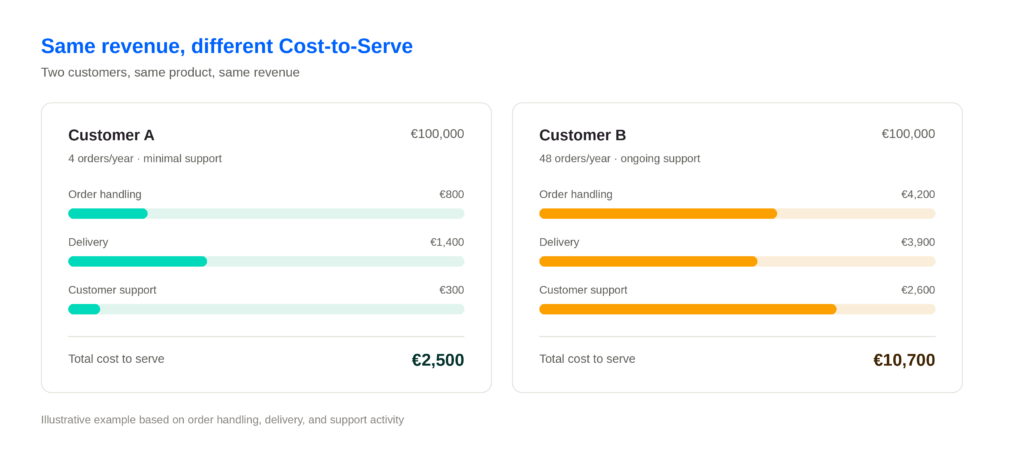
Two customers can generate the same revenue and still cost wildly different amounts to serve. Here’s how a cost to serve analysis uncovers the gap, the formula
If you have ever tried to answer what a product, a service or a customer actually costs you, a cost model is how you get there. It
Find the resources you need for your cost and performance management.
Read all the news and blogs about the industry and CostPerform.
See who we’ve helped before and how we could be a good fit to your organization.
Online | 22 October, 2026
A practical discussion on chargeback, TBM, cloud, AI, and the realities of technology cost management.
Alexandria, US | 2 November, 2026
Registration is now open and
agenda updates will follow soon!
Online | 12 November, 2026
A practical discussion on AI, profitability analytics, decision intelligence, and what it really takes to make AI defensible in banking.
Learn how to model your costs and profitability.
Understand the true cost of serving customers, channels, and products
Show how costs differ across customers, channels, and segments based on actual behavior.
Understand how customer behavior and service requirements influence profitability.
Link operational drivers directly to cost, creating clear cause-and-effect relationships.
Support pricing, segmentation, and service decisions with a clear view of cost.
Profitability is rarely determined by revenue alone. Customers, channels, and products consume resources in different ways, creating meaningful differences in cost.
Traditional financial reporting focuses on cost categories such as labor, IT, and overhead. While this provides a clear view of what is spent, it does not explain what drives those costs.
Support pricing, segmentation, and service decisions with a clear view of how cost is generated.
When the cost of serving customers is transparent, decision-making improves.
Cost to serve supports:
Cost to serve is a driver-based costing approach that connects operational activity to financial outcomes to calculate the true cost of serving customers, channels, and products.
Cost to serve is a driver-based costing approach that connects operational activity to financial outcomes to calculate the true cost of serving customers, channels, and products. Using CostPerform, organizations gain the transparency needed to understand profitability, improve efficiency, and make better-informed decisions.
Cost to serve helps organizations understand profitability by making visible the cost differences that occur when customers, channels, and products consume resources in different ways. Rather than only showing what was spent, cost to serve connects operational activities to financial outcomes so organizations understand why those costs occur, for example, why two customers generating the same revenue can have very different costs to serve based on order frequency and support needs.
Cost to serve supports pricing decisions based on full cost visibility, customer and channel segmentation based on profitability, service model optimization, and the identification of inefficiencies and cost drivers. Rather than relying on assumptions or averages, cost to serve grounds these decisions in a clear and explainable view of cost.
Cost to serve connects operational activity to financial outcomes by linking resources, activities, customers, and services within a structured cost model. Costs flow from resources to activities and then to customers or channels, reflecting how the business actually operates, which creates transparency into how operational behavior drives cost and enables more productive conversations between finance, operations, and business stakeholders.
In this whitepaper, you will learn about: