
If you are responsible for IT spending, you have probably faced one of these questions: what does this service actually cost, which business units are consuming the most, and are we getting value from our technology investments? That’s where IT Financial Management (ITFM) comes in.
This guide covers everything you need to know about ITFM: what it is, why it matters, how it compares to TBM and FinOps, the framework components, implementation steps, common challenges, and what to look for in an ITFM software platform.
Whether you are building an ITFM program from scratch or refining an existing one, this guide is your reference point.
Key Takeaways
- IT Financial Management is the discipline of making every IT cost traceable to a service, a consuming business unit, and a business outcome. It provides a shared and accurate view of what IT costs and what it delivers.
- Effective ITFM implementation depends on sequence: build the cost taxonomy before the allocation model, implement showback before chargeback, and define ownership before running allocations.
- AI costs, including GPU compute, LLM API consumption, and token-based usage, require new taxonomy layers and consumption-based allocation logic that most existing ITFM models were not built to handle.
- ITFM is not a one-time implementation. As IT environments change, the cost model needs regular recalibration to remain accurate and credible.
What is IT Financial Management (ITFM)?
IT Financial Management (ITFM) is the discipline of tracking, allocating, and optimizing an organization’s IT spending. Its goal is to make every technology cost traceable to a service, a consuming business unit, and a business outcome to create a shared, accurate view of what IT costs and what it delivers.
ITFM helps organizations ensure technology investments are aligned with business goals, identify waste, and manage budgets more effectively.
ITFM addresses four questions:
- What does this IT service actually cost?
- Which business units are consuming which IT resources?
- Which services cost more than they deliver?
- Which technology investments are worth expanding?
ITFM covers the full financial lifecycle of IT: from planning budgets and categorizing expenditures across hardware, software, cloud services, labor, and vendor contracts, to allocating those costs to the business units that consume them, to identifying where spending can be reduced, consolidated, or redirected.
The core components that make ITFM work in practice, including cost allocation, chargeback and showback, budgeting, and financial governance, are covered later in this guide.
Why is ITFM important?
For most organizations, technology spending represents a significant and growing share of total operating costs. According to Gartner, worldwide IT spending is expected to reach $6.15 trillion in 2026, and the pressure to account for every dollar of that spend is intensifying. Yet, according to Flexera’s 2026 State of the Cloud Report, an estimated 29% of cloud budgets are still wasted, and that figure only covers cloud.
The sections below cover what IT Financial Management makes possible: from cost transparency and accountability to strategic alignment and optimization.
IT Cost Transparency
Every IT expenditure, whether hardware, software, cloud services, labor, or vendor contracts, is categorized and attributed to the service it supports. The total cost of any IT service is thus visible at any level of granularity, from the full IT budget down to the cost per user of a specific application. Learn more about cost transparency and how it works in practice.
IT Cost Allocation and Accountability
Business units that understand what they are consuming, and carry financial responsibility for it, tend to make different decisions about how they use IT resources. That responsibility is made tangible through showback and chargeback (more on that later in the IT Framework components section).
Budgeting and Forecasting
ITFM replaces estimates with data. Finance teams can build forward-looking models based on actual consumption trends rather than prior-year actuals adjusted by a percentage. Historical cost patterns reduce budget surprises, sharpen forecasts, and produce investment cases that hold up when the CFO or board pushes back.
Informed Decision-Making
Investment decisions in IT, whether to consolidate vendors, retire an application, expand a platform, or migrate a workload to cloud, require accurate cost data to evaluate properly. With ITFM in place, technology and finance leaders can compare the true cost of alternatives, assess the financial impact of a proposed change, and build credible business cases for internal stakeholders.
Strategic Alignment
When every IT service has a known cost and a traceable connection to a consuming business unit or capability, leadership can evaluate whether technology spend reflects the organization’s priorities and reallocate where it does not.
Cost Optimization
ITFM provides the data to identify waste, consolidate redundant services, and rationalize vendor contracts. For example, when a storage vendor comes up for renewal, you walk in knowing exactly which business units are consuming that storage, at what cost, and whether utilization justifies the contract size.
ITFM vs TBM vs FinOps vs IT Budget Management: What Is the Difference?
ITFM, TBM, FinOps, and IT Budget Management are disciplines to optimize and control technology spending. These are not competing frameworks. Each operates at a different scope and maturity level, and most organizations adopt them in sequence: starting with IT budget management, building ITFM capabilities as cost complexity grows, adding FinOps discipline as cloud spend becomes material, and moving toward TBM when leadership needs structured visibility into how technology investments connect to business outcomes.
The table below summarizes the key differences:
Dimension | IT Budget Management | IT Financial Management | FinOps | TBM |
Primary question | Are we within budget? | What does each IT service cost, and who consumes it? | Are we optimizing cloud spend in real time? | Are our technology investments delivering business value? |
Scope | Total IT spend vs. plan | Full IT cost footprint by service and business unit | Cloud and SaaS spend | Full technology portfolio including business value |
Time horizon | Annual | Monthly to quarterly | Real time to monthly | Monthly to strategic |
Primary users | Finance, IT leadership | IT finance, CIO, CFO | Engineering, cloud ops, finance | CIO, CFO, board |
Key metrics | Budget variance, spend vs. plan | TCO, unit cost per service, chargeback rate | Real-time usage, cloud unit economics | Business value per IT dollar, investment ROI |
Output | Variance reports | Cost transparency, service costing, IT chargeback/showback | Cloud cost optimization, usage reports | Business value reporting, investment benchmarking |
Table 1. Comparing ITFM, TBM, FinOps, and IT Budget Management
Core Components of an IT Financial Management Framework
An ITFM framework is an operating model that translates IT costs into financial decisions, so every cost is attributable, justified, and connected to a business outcome. It covers six components, from how data is collected and costs are allocated, to how accountability is assigned and maintained over time.
Data Integration and Quality
Before any component works, cost data must flow reliably from its sources: the general ledger, cloud billing portals, ITSM platforms, and vendor invoices. Inconsistent or incomplete data at this layer undermines allocation accuracy, forecasting reliability, and the credibility of chargeback reporting.
Cost Transparency and IT Cost Taxonomy
A cost taxonomy maps every IT expenditure to a defined category:
- At the finance layer, cost pools such as labor, hardware, software, and cloud.
- At the IT layer, towers such as data centers and end-user computing.
- At the business layer, solutions and consuming business units.
Without a consistent taxonomy, the same cost means different things to different teams. The TBM taxonomy, maintained by the TBM Council, is the most widely adopted standard for this classification in enterprise IT.
Financial Planning and Budgeting
Compared to standard operational costs, IT costs are layered, complex, and increasingly variable (cloud services, SaaS subscriptions, AI costs…). A single business capability might draw on infrastructure, cloud services, and internal labor simultaneously, which a flat budget line cannot capture.
In IT Financial Management, budgets are built by service and cost category, tied to specific business priorities, and spend is tracked against those targets throughout the year. This gives the CIO and CFO a shared view with enough granularity to identify variances before they become overruns.
Showback and Chargeback
To allocate IT costs to the departments and business units that consume them, organizations implement showback and chargeback models. Showback reports IT consumption back to each business unit, creating cost awareness without transferring financial liability. Chargeback goes further, directly billing business units based on actual consumption. Most organizations implement showback first, building confidence in the allocation numbers before introducing financial recovery.
Financial Analysis and Forecasting
Once costs are visible and allocated, the next question is what the data is telling you.
Financial analysis surfaces where spending is growing faster than consumption justifies, which services are underperforming relative to their cost, and where the budget can be redirected.
Forecasting uses consumption trends and planned investments to project future spend, accounting for variable cloud and SaaS costs rather than treating the IT budget as fixed. Scenario planning takes this further, modelling how budget requirements shift under different strategic assumptions before committing.
Governance
Without governance, ITFM implementations degrade as organizational priorities shift or personnel change. Governance defines who owns each part of the financial process, who approves spending decisions, and how exceptions are handled. This keeps the model credible since allocations are traceable and numbers can be defended when challenged.
Note that as IT environments change, new services are added, consumption patterns shift, and cost structures evolve, the model will need regular recalibration to stay accurate. This is why governance is not just about ownership and approvals but about maintaining the framework over time.
Who uses IT Financial Management and how?
IT Financial Management impacts every function that sets budgets, consumes IT resources, or has to explain technology spend to the business. Its value looks different depending on where you sit:
- The CIO uses ITFM to move the conversation with the CFO beyond total cost. With accurate service costing and cost-per-capability data, the CIO can show what IT delivers and build investment cases that hold up under scrutiny.
- The CFO gains traceable, reportable IT expenditures that connect to the organization’s financial statements. Practical benefits include fewer budget surprises, more reliable forecasts, and stronger leverage in vendor renewals given that they are backed by usage data instead of estimates.
- The IT Finance team is the operational owner of ITFM. They build and maintain the cost model, run the allocation logic, and produce the reporting that gives IT and finance a shared, defensible view of what technology costs.
- Business unit leaders gain a clear view of what they are spending on technology, broken down by service and consumption. Cost visibility often changes behavior as teams that understand their IT consumption tend to make different decisions about what they request, what they renew, and what they are willing to pay for.
How to Implement ITFM: A Step-by-Step Approach
Here is a practical sequence you can follow to build and maintain an ITFM program from the ground up.
Step 1: Assess Your Current State
Before building anything, understand where you are starting from. Most organizations at this stage discover that costs are tracked at a high level but cannot be broken down by service or consuming business unit.
- Review how IT costs are currently captured in the general ledger.
- Identify what data exists by service, cost category, and business unit.
- Map where the gaps are between what you can see today and what you need to see.
- Assess how well current processes connect IT spending to business priorities.
Step 2: Define the Outcomes You Need From Your ITFM Program
Before you proceed to design, you should define what decisions the model should support to make it actionable.
- Agree on the primary goal (e.g., cost transparency, chargeback, benchmarking, or strategic alignment.
- Identify the outputs needed by each stakeholder (e.g., the CFO needs different reporting than a business unit leader).
- Set measurable success criteria (e.g., 100% of IT costs traceable to a business unit within 6 months, allocation accuracy rate above 95%, budget variance within 5% per service) so progress can be evaluated at each stage.
- Work backward from the target outcome to determine the scope of the model.
Step 3: Agree on a Cost Taxonomy
Build your cost model on a consistent classification structure to avoid discrepancies and time-consuming rework.
- Define cost pools at the finance layer (e.g., labor, hardware, software, cloud, facilities).
- Define towers at the IT layer (e.g., data centers, end-user computing, network, applications).
- Map solutions and consuming business units at the business layer.
- Before building any allocation logic, align IT and finance on definitions.
- Consider the TBM taxonomy as a widely adopted starting point rather than designing one from scratch.
Step 4: Build the Cost Allocation Model
Once the taxonomy is in place, map every IT expenditure to a service and from there to the business units consuming it. Data quality is the most common constraint at this stage.
- Choose an allocation method that follows cause-and-effect logic (rate-based, activity-based, or consumption-driven).
- Start with the data you have rather than waiting for perfect data.
- Validate allocation outputs with both IT and finance stakeholders before reporting them.
- Identify and resolve data quality issues iteratively as the model runs.
- Document allocation logic so it can be explained and defended when challenged.
Step 5: Implement Showback Before Chargeback
Once the allocation model produces reliable numbers, show them to consuming business units. Run showback for enough cycles that business unit leaders understand and trust what they are seeing before introducing financial recovery.
- Produce a bill of IT services by business unit and share it without financial consequence.
- Use early showback cycles to surface allocation disputes and data gaps.
- Gather feedback from business unit leaders on whether the numbers reflect their understanding of consumption.
- Introduce chargeback only once there is confidence in the allocation model on both sides.
Step 6: Govern, Report, and Iterate
Implement governance and reporting to avoid your ITFM model from degrading.
- Assign named owners for each component of the financial process.
- Define how allocation changes are proposed, reviewed, and approved.
- Establish a regular reporting cadence tailored to each audience: executive dashboards for the CIO and CFO, detailed cost breakdowns for IT finance, consumption summaries for business units.
- Review the model at least annually against changes in the IT environment, organizational structure, and business priorities.
- As the model matures, shift the focus from explaining costs to using cost data for forecasting, scenario planning, and investment decisions.
Common ITFM Challenges and How to Address Them
Common IT Financial Management challenges include siloed data and manual processes, the language gap between IT and finance, organizational resistance to chargeback, and legacy costs that limit budget visibility.
Siloed Data and Manual Processes
Most organizations track IT costs across multiple disconnected systems: ERPs, cloud billing portals, and vendor invoices. The Integris 2026 Banking Trust and Technology Report found that 64% of technology leaders lack full visibility into total IT spending because the data lives in systems that were never designed to produce a unified cost view.
Spreadsheets can fill the gap, but they cannot enforce allocation logic, maintain audit trails, or scale as the IT environment changes. For what to look for in dedicated ITFM platforms, see the tools section later in this guide.
The Language Gap Between IT and Finance
IT describes costs in technical terms (server counts, storage capacity, software licenses) and finance works in budget lines, cost centers, and variance reports. While that disconnect can trigger allocation disputes, a shared cost taxonomy addresses this issue structurally, but only if cost data is also translated into terms the business recognizes: cost per service, cost per transaction, cost per business capability.
Organizational Resistance to Chargeback
Business units that have historically received IT as shared overhead resist being billed for consumption they did not previously see as discretionary. Implement showback first to give them time to trust the numbers before introducing financial recovery.
Legacy Costs and Budget Visibility
Technical debt consumes IT budgets, leaving less room for strategic investment. According to KPMG’s Global Tech Report 2026, 43% of financial services technology leaders say the cost of fixing technical debt prevents them from investing in new technology programs. While ITFM does not eliminate that debt, it makes the cost of carrying it visible, which is the first step toward a defensible decision about what to do with it.
ITFM best practices
Choosing the right sequence matters when building your ITFM program. Here are some best practices that show you how.
Start with Allocation Before Cost Optimization
Build a clean cost allocation model before pursuing cost reduction. When IT spend comes under pressure, the instinct is to cut. However, the more durable move is establishing where every cost actually goes first. Once expenditures are attributed to a service and a consuming business unit, waste surfaces on its own.
Sequence Showback Before Chargeback
Implement showback before moving to chargeback. While you aim to create accountability through showback and chargeback models, introducing financial recovery before business units trust the allocation numbers can lead to disputes. Therefore, first build that trust with showback by making IT consumption visible without financial consequence.
Build the Taxonomy Before You Build the Model
Agree on how costs will be classified before building the allocation model. Having a consistent taxonomy across IT and finance, what counts as labor, what counts as infrastructure, how cloud costs are categorized, before building allocation logic saves significant rework later. There is no need to start from scratch, the TBM taxonomy is a widely adopted starting point.
Tie IT Budgets to Business Priorities
Budgets built by rolling forward prior-year actuals with a percentage adjustment don’t reflect current needs. Start from what the business has decided to build, run, and maintain, and work backward to the cost of delivering it.
Define Ownership Before the First Allocation
Define who owns the cost model, who approves allocation changes, and how disputes should be resolved before running the first allocation. Doing so will help you spend less time defending the numbers and give you more time to act on them.
AI Is Becoming One of the Hardest IT Costs to Manage
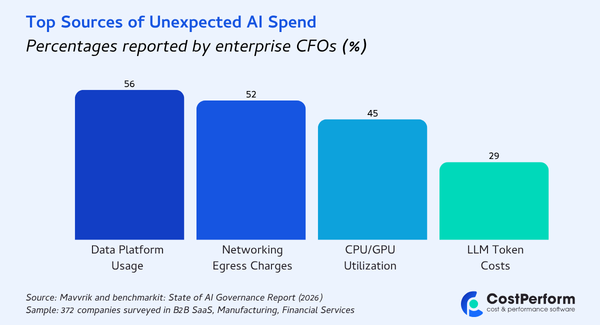
AI infrastructure, GPU compute, and LLM API consumption are consumption-based, variable, and often purchased outside central IT oversight. Unlike cloud compute, which maps to established cost categories, AI costs are driven by consumption units that existing taxonomies do not yet classify.
The scale of the problem is growing fast. According to Gartner, worldwide AI spending is forecast to reach $2.59 trillion in 2026, a 47% increase year-over-year, with AI infrastructure accounting for over 45% of that total. Gartner also notes that CIOs currently face challenges proving the value of AI investments and demonstrating tangible business outcomes. That gap between spend and demonstrable return is the problem ITFM is designed to close.
Managing AI spend requires the same ITFM foundations applied to cloud, with additional layers most cost models were not built for:
- GPU and inference costs behave differently from standard compute. A single LLM workload can consume more in an afternoon than a traditional server costs in a month, and that cost is untraceable without consumption-based allocation logic in place.
- AI tools purchased outside central IT create the same shadow spend problem as consumer SaaS, but with a faster and less predictable spend curve.
- Token consumption and model usage require a unit economics model that scales with usage, not a fixed monthly license cost that traditional budgeting assumes.
One of the most overlooked aspects of AI cost management is token allocation. Unlike a software license or a compute instance, tokens are consumed across multiple projects, teams, and use cases simultaneously, making it difficult to attribute costs to the right owner. Ensure your ITFM cost taxonomy includes AI consumption units before the spend grows too large to trace back to the teams and projects that generated it.
ITFM Tools: What to Look For
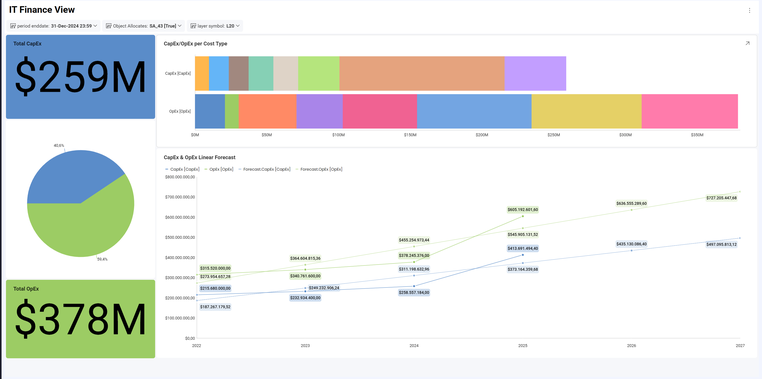
Spreadsheets can model a cost allocation structure, but they cannot enforce it, automate it, or maintain it as the IT environment changes. At a certain level of organizational complexity, manual approaches become the constraint on what ITFM can deliver, not the cost model itself.
IT Financial Management software solve that by operationalizing the financial governance that this guide describes: automating data aggregation, enforcing allocation logic, and creating defensible cost reports. When evaluating platforms, focus on the capabilities that determine whether the cost model remains credible over time:
- Cost model engine: The ITFM platform should enforce allocation logic. If resolving an allocation dispute requires manual reconstruction, the platform is not doing its job.
- Data aggregation: Automatic aggregation from ERP, GL, cloud providers, ITSM tools, and licensing systems. Avoid manual data preparation before every reporting cycle, which introduces a governance risk.
- Allocation flexibility: The tool should offer support for rate-based, activity-based, and consumption-driven methods. The allocation method should follow the cost structure and not be constrained by what the tool supports.
- Showback and chargeback reporting: Automated bill of IT by business unit, with audit trails that make the numbers defensible when a department disputes its allocation.
- Forecasting and scenario modeling: Look for forward-looking financial modeling. Variable cloud and AI costs require dynamic forecasting rather than static annual projections.
- TBM taxonomy support: If the goal is connecting IT costs to business outcomes, the platform needs to support a structured cost taxonomy that maps to the TBM framework.
- Auditability: Every allocation should be traceable back to its source. Numbers that cannot be explained to a regulator, auditor, or CFO are not fit for enterprise use.
CostPerform gives CIOs and IT finance leaders a governed, defensible cost model for ITFM, built on activity-based costing, TBM taxonomy-driven allocation, and multi-dimensional cost modeling. It gives full visibility into what IT costs, who consumes it, and whether it is worth it, with numbers that hold up under scrutiny.
Do you want to keep learning about ITFM and TBM? Watch our webinar TBM: Cost Allocations for IT and Beyond for a practical look at how organizations apply the TBM framework in practice. Or contact us if you want to discuss how CostPerform can support your ITFM program.
FAQs about IT Financial Management (ITFM)
What is the IT financial management process?
The IT financial management process moves through five phases: cost accounting and taxonomy, budgeting and forecasting, cost allocation through showback and chargeback, financial analysis and optimization, and governance.
What are the benefits of IT Financial Management?
The main benefits of IT Financial Management are cost transparency, spending accountability, and more defensible investment decisions. It gives finance and IT a shared view of what each service costs, who consumes it, and whether it is delivering value, surfacing the costs that justify themselves and the services quietly driving up spend.
What is the difference between ITFM and TBM?
ITFM focuses on making IT costs visible, traceable, and allocated. TBM builds on that foundation by connecting those costs to business outcomes and strategic priorities. A simple way to distinguish them: ITFM answers what IT costs, TBM answers whether it is worth it. For a deeper dive, read our guide on ITFM vs TBM.
What is the difference between ITFM and FinOps?
ITFM covers the full IT cost footprint including infrastructure, software, labor, and cloud. FinOps focuses specifically on cloud and SaaS spend, applying real-time financial discipline to variable, consumption-based costs.
What does an IT financial management tool do?
An IT financial management tool gives IT finance teams a single governed view of all technology costs by automating data collection, enforcing allocation logic, and producing showback and chargeback reporting at enterprise scale. Spreadsheets can model a cost structure but cannot enforce it or maintain it as the organization changes, which is where dedicated platforms earn their place.
How do you measure the success of an ITFM program?
Key metrics include percentage of IT costs traceable to a business unit, allocation accuracy rate, budget variance by service, and time to resolve allocation disputes. At the strategic level, success means IT and finance are working from the same cost model and investment decisions are backed by traceable data.