
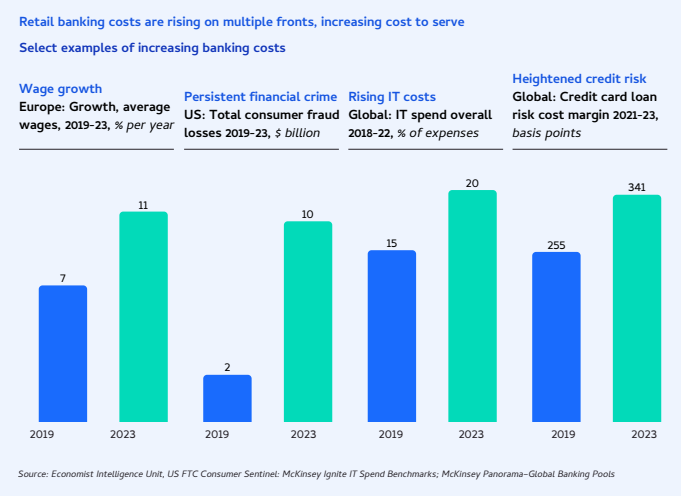
In today’s margin-compressed banking environment, cost optimization in banking can no longer rely on one-off cuts to protect cost-to-income ratio. The relief is temporary. Within 12 to 18 months, the cost base rebuilds and you are back in front of the board explaining why profitability has not structurally improved (McKinsey).
The risk is not cost creep alone. It is cutting into the muscle that protects margin: critical talent, risk infrastructure, and digital investments. Reducing spend is easy under pressure. Redesigning the cost structure without weakening capital flexibility, competitive position, or regulatory standing is far harder.
Leading banks are shifting from one-off cuts to structural cost redesign. Activity-based costing in banking across product, segment, and channel reveals where margin is destroyed, which products fail to earn their cost of equity, and where cost-to-serve erodes returns.
“Cost optimization is not about spending less. It’s about allocating every dollar to the activities that protect ROE under margin pressure.”
– Sander Den Hartog, CEO at CostPerform
The approach structurally improves efficiency ratio, strengthens profitability, and creates capital headroom to fund AI and digital modernization without recurring cost-cutting programs. To stay ahead of cost pressures, banks are building strategic cost management programs around two core principles:
Principle 1: Identify Cost Optimization Opportunities in Banking Now
Start with rigorous cost transparency. Bank executives audit cost structures to expose hidden ‘bad costs’, such as manual work, redundant controls, fragmented systems, and products with poor cost-to-serve economics. Cost transparency reveals not only where capital flows, but why. Without it, Finance cannot credibly answer the board’s most difficult profitability questions.
In 2026, US banks are prioritizing 5 key cost optimization initiatives:
1. Branch and footprint drilldown
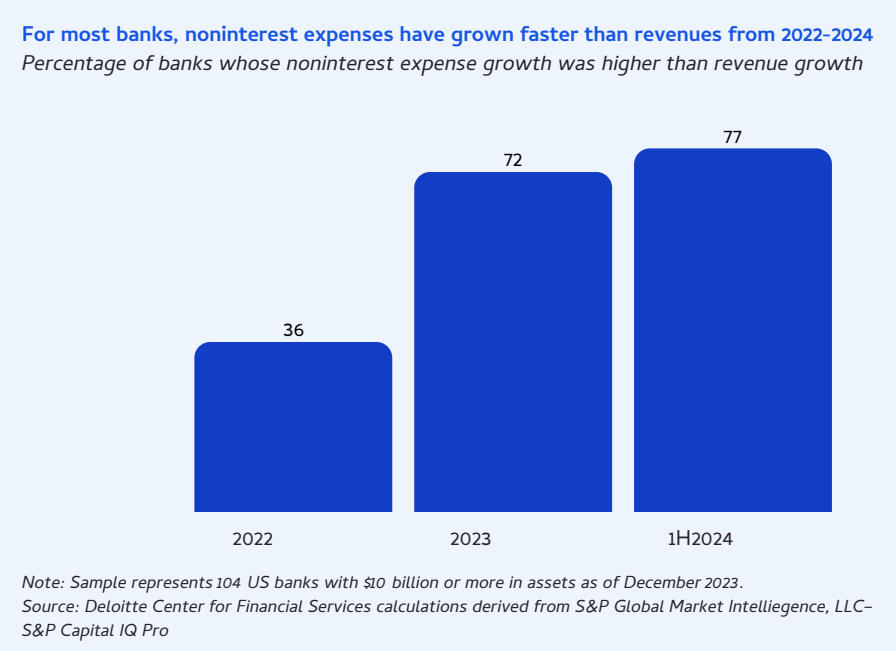
Many North American banks continue operating at cost-to-income ratios around 60%. Overlapping branches and underused real estate inflate noninterest expense without sufficient return. Regional banks that expanded pre-COVID now face the reality of excess footprint.
Granular profitability analysis allows you to assess branch economics by segment and market, supporting data-backed consolidation decisions. The benefit is immediate: efficiency ratio improvement within reporting cycles, capital freed for reinvestment, and footprint optimization without compromising client coverage or regulatory commitments.
2. Automation, cloud computing, and AI
Modernizing back-office operations with RPA, machine learning, and agentic AI removes manual reconciliations and legacy inefficiencies that inflate OPEX. Reporting, loan processing, and onboarding become faster and less labor-intensive. More than 50% of bank executives are investing in Generative AI and 38% expect operating cost reductions. The opportunity is lower run-the-bank expense, and better visibility into profitability by product and channel.
There is real financial risk. If you automate before simplifying, you hardwire broken processes into your operating model and future cost base. Simplify and reengineer before you digitize. Do not automate complexity.
3. Process improvement and understanding demand
Manual procedures have survived for years despite offering zero ROI. Mortgage origination costs doubled from roughly $5,100 in 2012 to $11,600 in 2023 due to layered compliance and bolt-on systems. In response to rising costs, banks typically focus on quick budget cuts within mortgage operations. These typically include measures such as reducing staffing in processing or underwriting teams, limiting vendor spending, postponing technology upgrades, or tightening departmental budgets.
A strategic approach asks, “Should this activity exist at all?” Exiting sub-scale product lines, eliminating low-value processes, or redesigning workflows can deliver more durable cost takeout. The objective is to protect margins without weakening client experience or regulatory standing, the trade-off every CFO fears.
4. Third-party spending and procurement
Non-labor cost rationalization prevents capital leakage. Banks carefully review vendor contracts, software licenses, marketing, and travel. By consolidating suppliers, leveraging scale purchasing, or joining consortia, banks strengthen negotiating power, lower structural OPEX, and improve earnings predictability without reducing frontline capacity or constraining growth investment.
US banks are mirroring UK peers by tightening discretionary spending, including employee travel and entertainment, while protecting revenue-enabling capabilities. Aim to structurally lower noninterest expense, not another temporary cost program.
5. Organization and workforce efficiency
Labor is the largest expense for most banks. Structural efficiency requires thoughtful workforce restructuring, not across-the-board cuts.
Following its merger, Truist Bank consolidated businesses, closed redundant branches, and streamlined headcount to improve operating leverage, resulting in $750M in cost savings. Leading US banks use attrition, selective redundancies, reskilling, while smaller banks rely on outsourcing, and shared infrastructure (e.g., payments platforms) to benefit from scale. When executed together, these actions can deliver 3-5% structural cost reduction in banking, and up to 10% for top performers, with savings sustained through recurring cost discipline rather than one-off programs.
Principle 2: Build a System of Ongoing Cost Reduction in Banking
As highlighted earlier by McKinsey, short-term savings don’t last without strong governance. Sustainable efficiency and cost reduction in banking require structural governance.
CFO-Led Performance Management
Cost accountability must cascade through the organization. Clear cost targets by business unit, aligned to enterprise-wide efficiency goals, create ownership. Several banks tie management compensation to cost objectives, balanced with customer service and risk metrics to avoid unsafe cuts. Performance reviews must address expense variances with the same rigor as revenue shortfalls. Ultimately, the CFO must drive a “performance-oriented culture” where teams manage cost and profitability together.
Zero-based budgeting (ZBB) and Cost Ownership
Incremental budgeting institutionalizes inefficiency. ZBB forces departments to justify spend from zero, challenging legacy systems, redundant applications, and underperforming initiatives before they quietly dilute ROE. This approach reduces institutionalized waste and aligns spending with forward strategy.
Continuous Monitoring and Cost Governance
Updated cost models must reflect product changes, system upgrades, and organizational shifts, otherwise cost creep quietly rebuilds before the next board review. Managers must understand how operational decisions impact the efficiency ratio. When accountability extends beyond Finance into frontline leadership, savings hold and margin remains defensible under scrutiny.
The principle is straightforward: economic truth over accounting convenience. Transparency enables accountability, and accountability protects margin.
What’s at Stake for Cost Optimization in Banking?
Even a 5% improvement strengthens ROE, frees capital for AI, and puts you back in control of your margin, while competitors remain trapped in recurring cost programs.
Bring the plan to action through cost optimization in banking by structurally lowering your efficiency ratio. The US average sits around 58-60%, leading Nordic banks operate closer to ~42%, and closing that gap could unlock up to $200 billion in industry-wide savings between 2026 and 2028. For more on this, read the Cost Optimization in Banking Playbook.
Frequently Asked Questions
What is cost optimization in banking?
Cost optimization in banking is the structural redesign of a bank’s cost base to protect margin and return on equity, rather than relying on one-off cuts. As CostPerform CEO Sander Den Hartog explains, cost optimization in banking is not about spending less, it is about allocating every dollar to the activities that protect ROE under margin pressure.
What is the difference between cost reduction and cost optimization in banking?
The difference between cost reduction and cost optimization in banking is durability. Cost reduction in banking typically refers to one-off cuts that provide temporary relief, with the cost base rebuilding within 12 to 18 months. Cost optimization in banking, by contrast, is a structural redesign that identifies which products, processes, and activities fail to earn their cost of equity, delivering savings that hold over time rather than eroding after the next budget cycle.
What are the most effective cost optimization strategies in banking?
The most effective cost optimization strategies in banking fall into five categories: branch and footprint drilldown, automation and AI adoption, process improvement, third-party spend rationalization, and organization and workforce efficiency. When executed together as part of a structural cost optimization program, these strategies can deliver 3 to 5% structural cost reduction, with top-performing banks achieving up to 10%.
How much can banks save through cost optimization in banking?
Banks can save 3 to 5% through structural cost optimization in banking, with top performers achieving up to 10% when the five core initiatives, branch drilldown, automation, process improvement, procurement rationalization, and workforce efficiency, are executed together.
Is cost reduction in banking sustainable long-term?
Cost reduction in banking is generally not sustainable long-term when it relies on one-off cuts, since the cost base typically rebuilds within 12 to 18 months, according to McKinsey. Sustainable cost reduction in banking requires structural governance, including CFO-led performance management, zero-based budgeting, and continuous monitoring, so that savings hold rather than quietly eroding before the next board review.