
Artificial Intelligence (AI) costs have ballooned for companies in 2026. The percentage increase year-on-year is so high, that it’s hard to track. One of the big AI model providers, Anthropic has reported a 12-fold increase in revenue as it prepares for an IPO. Gartner expects a further 49% increase in total AI spend by companies in the next year. In this article, I’ll explain how large organizations should manage their AI costs against this backdrop.
Starting with low-hanging fruit
Because these costs have blown up so quickly, in many cases with no guardrails, there are some areas that can be identified quickly as a major culprit. At one small consultancy CostPerform encountered, a sole developer was responsible for 80% of a suddenly spiking OpenAI bill.
Model-routing is another clear target. Without being told or advised otherwise, employees typically deploy the most powerful model at their disposal, even when engaging in simple tasks. Behaviours can be addressed here with employee communication or an internal memo. It can be helpful to point out that cheaper models can be better. Cheaper models create an answer faster, and take in less context (and less noise). Fascinatingly, they outperform frontier models in certain tasks.
Building a system for AI cost control
Starting with ad-hoc fixes is rarely the solution to long-term business challenges. And there is every indication that AI spend is a long-term challenge to the office of the CIO and CFO.
So tackling AI spend requires building an enterprise-ready system. This requires organizational buy-in, and more significant resources. However, the organizational appetite to put this system in place is high.
According to Gartner, building ROI from AI is enterprise CEO’s top priority in 2027. According to this outline of strategic direction, enterprises may even build out a dedicated AI cost function in 2029. As the difficulty of tracking discrete tokens has totally uprooted traditional accounting, and IT spend analysis.
Building the system. Where to start?
In principle, an AI cost control system should start with collecting all the relevant costs across the organization. This is building an inventory essentially. Model-API’s like Open AI and Anthropic, cloud-hosted AI like Bedrock or GCP, and even embedded AI features inside other tools may need to be identified and disentangled.
Examining credit cards, expensed subscriptions, or procurement contracts is the foundation work of understanding the AI spend in the organization. Some steps will be easier than others, big providers like Anthropic have API-keys that can be connected with tools in the next step.
Step two in the AI Spend System: Centralize the data
Pulling financial data from every corner of the organization is only useful when it can be examined, understood, and allocated appropriately. The next step is building or buying a tool that is capable of centralizing your analytics efforts.
This should include attribution, whether it’s by provider, model, department or project. And standard features like budgets and alerts.
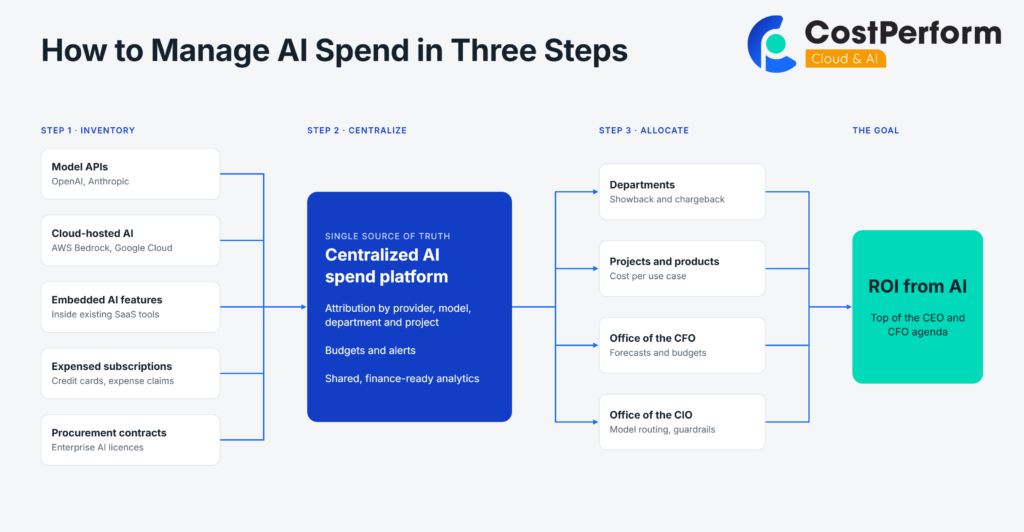
Finally, feeding the centralized platform back to the rest of the organization
After centralizing, you have the model at your disposal. With this in place, you can deal with ad-hoc requests in minutes, you can proactively allocate AI spend to the organization, or can set-up trigger alerts for anomalous spend. Put simply, with a system like this in place you can start to display, disprove or analyse your ROI on Artificial Intelligence.
Which tools to put to work
AI cost tooling falls into a few categories, and large organizations usually end up combining them.
Provider dashboards and gateway: Anthropic, OpenAI and the cloud platforms offer their own usage views. LLM gateways like Portkey can also enforce budget caps and model routing. These are useful, but only allow insight to a slice of the spend
Observability tools. Platforms like Langfuse show what individual prompts and features cost. These tools are valuable for engineering teams, but less suited to FinOps, or finance team use-cases
Cost-management platforms. This is where centralization happens. CostPerform Cloud & AI brings AI spend from model APIs, cloud-hosted AI and embedded features into one view, with attribution by provider, model, department and project, and budgets and anomaly alerts.
Managing Cost for AI
AI costs won’t settle down quickly, or by themselves. The organizations that fare best will be the ones that can act fast to build a system. They will what they’re spending, tie it to outcomes and adjust quickly. When evaluating a tool, start with a category close to your biggest blindspot. If you don’t do model routing, go for that. The biggest ROI will be in the area that is not yet on your radar.
About CostPerform
CostPerform has been provding best-in-class cost modeling software to enterprise and government clients since 2001. CostPerform’s core software excels at understanding an organization’s costs, allocating them, and incorporating this with financial processes, showback, chargeback, and other systems (ERP and BI). In 2026, CostPerform launched it’s CostPerform Cloud & AI product. With Cloud & AI, we help organizations understand their wider AI costs and how this feeds into the central cost models and total IT spend of the organization.