
As 2027 rolls around and a new cycle in banking begins, some things change and some things stay the same. Rates are climbing again and the ECB is about to change hands, while geopolitics and AI keep adding risk to the balance sheet and the cost base. Below are four predictions for European banks in 2027, set against one boon and three risks that will shape them. This content builds on CostPerform’s Banking Playbook for 2026 to 2028.
Setting the background: bonanza years behind, rates head back up
Interest rates will keep trickling up in 2027. The ECB, the Fed and other central banks in mature markets have already started edging upward in 2026 as they seek to curtail bubbling inflation, and the energy shock from the Middle East conflict gives them reason to keep going. The Fed raised rates in September for the first time in three years.
European banks have benefited from a series of bumper years. Moving interest rates have allowed them to capture enormous value since the first rate rises in 2022 after a decade of stagnation. The good news? The ECB rate hike cycle has begun again. After a year at 2.00%, the deposit facility rate went up in June and again in September 2026, to 2.50%. Rates will rise again in 2027.
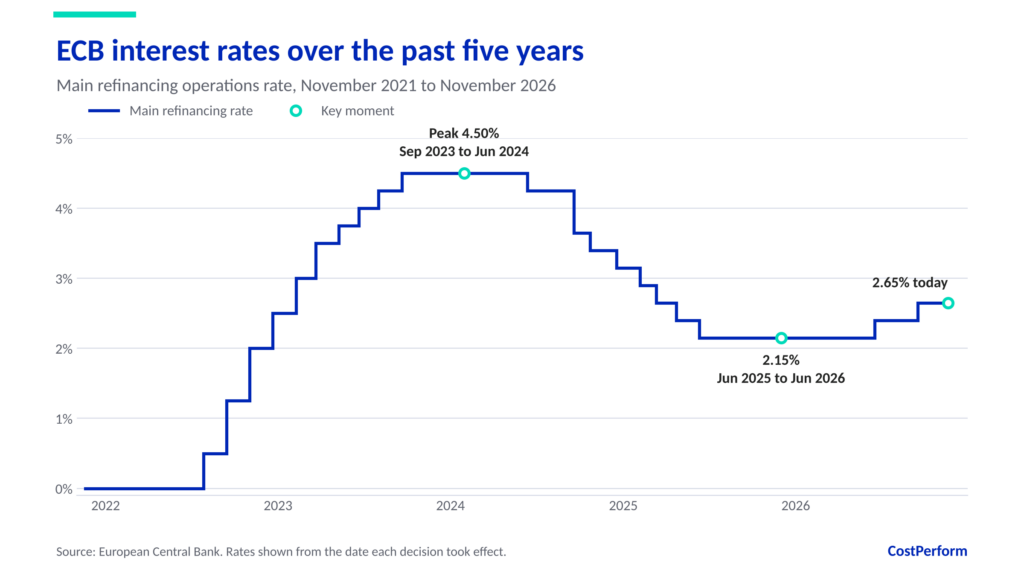
The ECB main refinancing rate, 2022 to 2026. Source: European Central Bank
They will rise from a lower base, though. Even after this year’s hikes, the deposit rate sits well below the 4% peak of 2023 and 2024. For the cost-to-income ratio, that makes 2027 a test rather than a gift. Higher rates widen net interest margin, but deposit competition and funding costs follow them up. The ratio only improves if the cost base holds still while income rises, and most finance teams remember how quickly costs filled the space last time.
Prediction #1: Rates rise again in 2027, but stay below the 2023 to 2024 peak
Who takes the ECB?
Christine Lagarde will step down on February 7, 2027, almost nine months before her term ends. Spaniard Pablo Hernández de Cos looks likely to take her place.
For a long time, the head-to-head was too tight to call (our office poll in early November thought the Dutchman Knot would get the nod). Berlin had other ideas. On November 17, Germany put Princeton economist Markus Brunnermeier forward as ECB chief economist and signaled its support for Hernández de Cos, a week after Paris did the same. A Spanish president with a German chief economist keeps the North/South balance on the Executive Board.
For banks, the name matters less than the balance around it. With inflation running well above target, whoever takes the chair inherits a Governing Council that is still debating further hikes.
Prediction #2: Hernández de Cos takes the ECB presidency, and the hawks hold their ground on the board
On-going boons, several risks
So a confluence of factors, friendly politics and rising rates sets the background for a banking environment that can continue to grow healthily, in both balance sheet and interest margin terms.
Boon #1: Business as usual implies profitability
But this run of positive factors is not a given. Next, we look at three risks that are present for banks. Geopolitics continues to loom large, while AI throws up risks on both the macro and the micro scale.
Geopolitics at play
Geopolitics has been, and will continue to be, the biggest single risk factor for European banks in 2027. In 2022, the same year that rising interest rates helped create the current profitability bonanza, the most present example of a geopolitical risk factor also began: the Russian invasion of Ukraine.
From a European perspective, a hostile actor waging hybrid war at its doorstep continues to be the largest single risk factor for the banking sector. Cyberattacks, economic disruption and funding questions loom over the crisis. This year’s energy shock is a reminder that the pressure does not only come from the east. In this world, high-quality, high-variability scenario analyses prove their value.
The US/Europe split is another risk. Although Europeans will hope that a democratic sweep in the November mid-terms helps relations that have split in recent years, the US/Europe partnership is still structurally unwinding. Deglobalization is still going to be a continuing factor.
Risk #1: Changing politics doesn’t prevent a US/Europe split
AI on the macro scale: capital and cyber
On the AI front, the macro lens reveals another set of challenges for European banks. AI creates its own risks, both in how the technology is financed and in the collateral damage it may cause.
For financing, the massive scale of the AI infrastructure buildout has driven up bond yields. Hyperscaler debt issuance passed $200 billion by mid-August 2026, and investors are demanding higher returns to absorb it. This has created a competition for capital that could increasingly hurt a bank’s asset mix.
On the macro scale, we also see the risk of collateral damage from the technology itself. Cyberattacks are taking an increasing slice of European business leaders’ attention. As mentioned in the context of geopolitics, cyber vulnerabilities are a huge risk area for banks. With a combination of the means (AI) and the motive (geopolitical bad actors), banks are investing in security measures like never before. Mandatory DORA compliance and ECB stress tests keep raising the floor of spending. Beyond that, cybersecurity threats have only increased in impact, complexity and scale.
Prediction #2: Consequential cyber-events will impact European banks in 2027
Boom and bust
Finally, on the macro scale, the boom-bust AI investment cycle could crash. The implications of this are hard to predict. But given the scale of capital invested, the AI model companies and tech hyperscalers need to start seeing return on investment sooner rather than later. Gartner now expects worldwide AI spending to reach about $4 trillion in 2027, a 47.5% jump in a single year.
A correction would reach banks through more than one door. Loans to data center developers and the wider AI supply chain sit on the balance sheet. Bond and equity holdings reprice. And the AI services banks buy could get more expensive, as prices increase
Risk #2: AI macro: Financial pressures spark from AI financing.
AI on the micro scale: proving the profitability
AI has to show up in the P&L. Gartner forecasts that spending on AI software will grow 42% in 2027, while AI services are expected to rise by 29.5%. With this in mind, banks are shifting to advanced measurement, tracking and ROI on these investments.
That is harder than it sounds. AI spend at a bank rarely sits in one place. Part of it is in the IT budget, part in cloud bills with usage-based pricing, part in vendor contracts, and a growing share in the business lines that spin up their own tools. The uncomfortable truth is that many banks can tell the board what they spend on AI in total, but not which products, processes or customers that spend serves, or what it returns. For a cost-to-income ratio, an unexplained AI line looks the same as any other cost creep.
The banks that get ahead here treat AI like any other shared cost. They trace it from the invoice to the activities it supports, then on to the products and customers, and they compare it with the savings or revenue it was meant to bring. Showback and chargeback make the cost visible to the people who use it. Our guide on how to manage AI costs goes deeper, and CostPerform Cloud & AI brings cloud and AI spend into the same model as the rest of the cost base.
Prediction #3: In 2027, AI moves out of the innovation budget and into the P&L, measured, allocated and held to an ROI
Cost transparency is the common thread
Rising rates, a new ECB president, geopolitics and AI all raise the cost of ambiguity. When income moves this much, a bank that cannot explain its cost base cannot tell whether a better cost-to-income ratio came from good management or from the ECB.
The reverse is also true. Banks that can trace their costs to products, processes and customers know which margin gains to bank and which to protect, and they can run the scenarios before the next shock instead of after it. In 2027, that is what separates riding the cycle from depending on it.
Want to learn more?
CostPerform’s Banking Playbook outlines what banks can do to succeed in this next cycle, from identifying key trends like the above to best practices for cost optimization in banking. The playbook was informed by insiders with decades of experience in banking in the United States and Europe.