
IT costs in banking are growing faster than revenue. According to McKinsey, technology spending in banking has been rising 9% per year on average, more than double the revenue growth rate of 4%. Yet despite this enormous spend, most banks struggle to explain where the money is actually going.
This is not a new problem. But in 2026, it has become urgent.
The numbers are hard to ignore
Deloitte’s latest CFO research found that 15 out of 26 large European banks expect cost growth to outpace revenue growth, making IT cost discipline not just a management issue, but a profitability one.
Even JPMorgan Chase, which is committing $19.8 billion to technology in 2026, is focused on doing more with discipline. CFO Jeremy Barnum described how the bank spent 2025 building a culture of “living within its means”, resisting unnecessary headcount growth and embedding efficiency from the ground up. If the world’s most well-resourced bank is instilling cost discipline, European banks operating under tighter margins have even more reason to act.
The transparency gap is widening
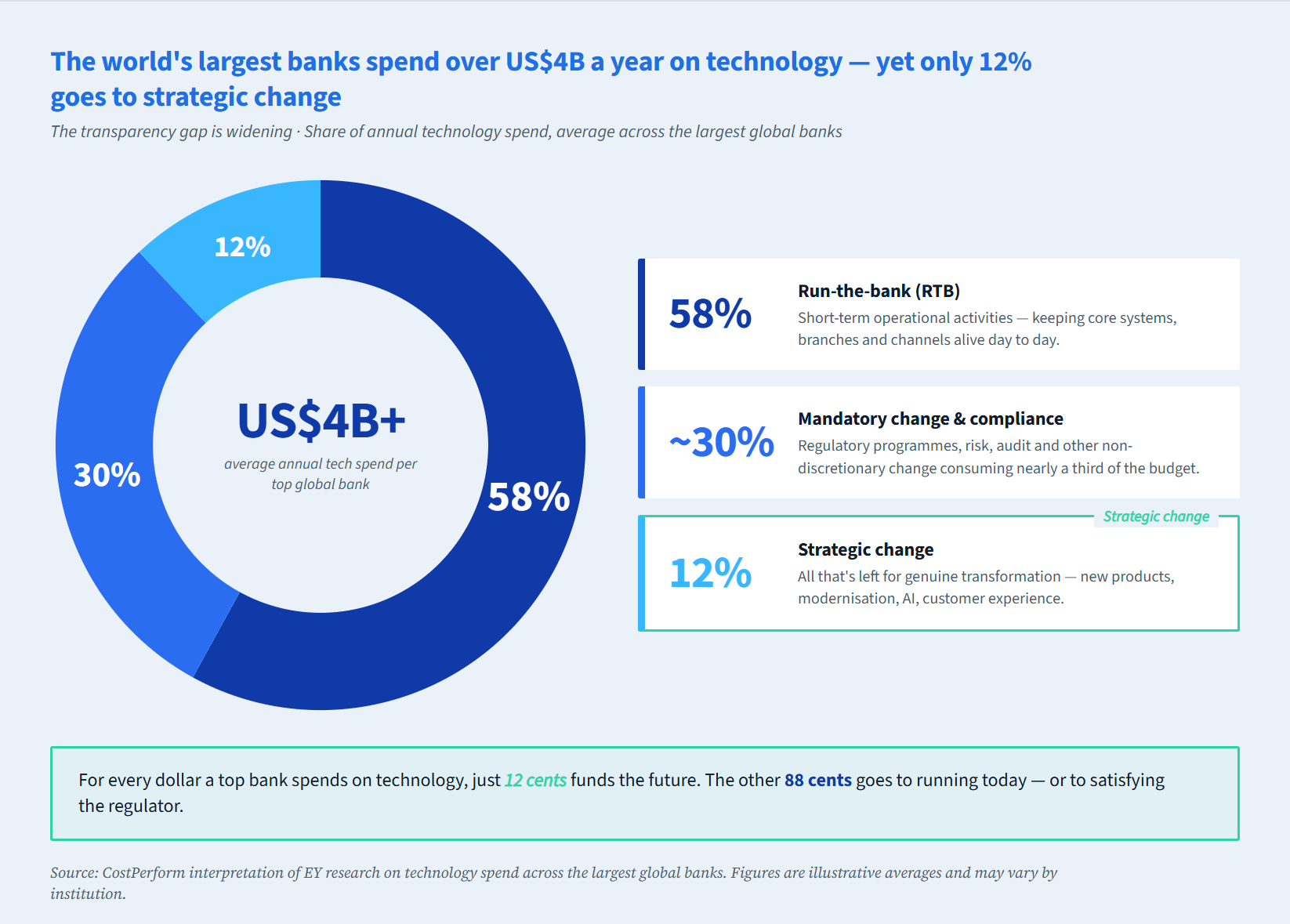
The problem is not how much banks spend. It is how little of it reaches the right place. EY’s research across 25 major global banks found that 58% of technology spend goes to short-term run-the-bank activities, while nearly a third is absorbed by mandatory change and compliance. That leaves just 12% directed at strategic change.
A large part of the reason is technical debt. KPMG’s Global Tech Report 2026, based on a survey of 760 financial services technology leaders, found that 43% say the cost of fixing technical debt actively prevents them from investing in new programmes. Legacy systems don’t just cost money to run, they quietly consume the budget that should fund the future.
The result is a visibility problem that runs across the whole organisation. The Integris 2026 Banking Trust and Technology Report found that 64% of bank leaders say they lack full visibility into total IT spending, even as 45% expect their technology budgets to rise by at least 40% this year.
This is the heart of the IT cost allocation challenge. Most banks do not run a single cost model. They run several: one for regulatory reporting, one for business unit allocation, one for technology management. Each tells a different story. Separating run costs from change costs should be straightforward. In practice, for most banks, it is not.
Without that clarity, basic questions go unanswered on:
- What does it actually cost to run a specific product or service?
- Where is transformation spend going, and is it delivering?
- How do we allocate cloud costs fairly across business lines?
Deloitte’s 2026 Banking and Capital Markets Outlook is direct: banks will remain laser-focused on costs in 2026, with technology spending among the key pressures on efficiency ratios. As the Banking Predications 2026 puts it: banks that cannot explain their cost base will struggle to defend their strategy to boards, regulators, and investors.
Structured frameworks like IT Financial Management (ITFM) and Technology Business Management (TBM) exist precisely to address this, but adoption remains uneven across European banks.
Regulation is raising the stakes
DORA, fully in force since January 2025, requires banks to formally map ICT dependencies and demonstrate oversight of third-party providers. Effective IT cost governance is no longer optional, it is a regulatory baseline. The ECB has also flagged that 38% of major IT incidents in 2025 were caused by IT change failures, a direct consequence of poor cost governance and visibility.
What good looks like
ING, one of Europe’s most digitally advanced banks, has spent years building and refining its IT cost modeling approach. Their experience shows that there is no single right model, but there is a right approach: one where different cost perspectives coexist, evolve, and inform decisions at the right level of the organisation.
Hear it from the inside
On 23 June 2026, Sander den Hartog (CostPerform) sits down with Arjan Verhoeff (ING Bank) to explore exactly how this works in practice. Together they cover how ING structures and allocates IT costs, why multiple cost models coexist, how AI and IT investment is moving the needle for cost optimisation, and what it takes to align cost information for better decisions across a complex banking environment.
If banking IT cost management is on your agenda in 2026, this is a session worth attending.