
Funds Transfer Pricing (FTP) Defined
Funds transfer pricing is the internal mechanism banks use to allocate the cost and benefit of funds between business units. Treasury acts as an internal counterparty: it charges lending units for the funds they deploy and credits deposit-gathering units for the funds they raise. The difference between those charges and credits, stripped of credit risk and operating costs, isolates each business unit’s true contribution to net interest income. FTP converts a bank-wide interest rate spread into unit-level economic accountability.
Why Funds Transfer Pricing Matters for Banks
Net interest margin is the central profitability metric for most banks. It is also one of the most misleading, if it is reported only at the aggregate level.
A bank earning a 3.2% NIM may have a mortgage division that is destroying economic value, a deposit franchise that is subsidizing the lending book, and a treasury function that is absorbing interest rate risk that should belong to someone else. None of that is visible in the aggregate figure. FTP is the mechanism that disaggregates NIM and assigns it correctly.
Without a functional FTP framework, the following distortions are routine:
- A fixed-rate mortgage originated in a low-rate environment looks profitable until rates rise, because the funding cost assigned to it never reflected the true duration mismatch.
- A high-volume deposit-gathering branch receives credit only for the balance it gathers, not for the stable, low-cost funding that deposit represents to the institution.
- Business units price loans based on observable market rates, not on the actual cost of funding those specific instruments, which leads to systematic mispricing.
- When interest rates shift, management cannot model the impact by business line because the FTP framework is too crude to respond at that level of granularity.
FTP is not a compliance exercise. It is the analytical foundation for pricing discipline, business unit performance measurement, and treasury risk management. Banks that treat it as a secondary concern pay for that choice in mispriced products, misdirected incentives, and reporting that does not support real decisions.
How Does Funds Transfer Pricing Work? The Core Mechanics
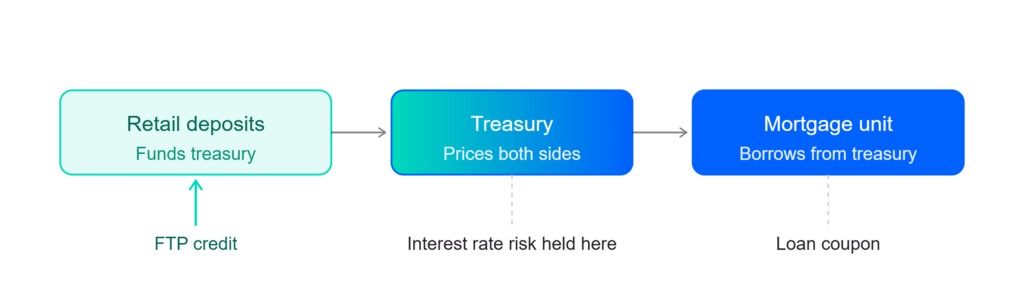
The basic architecture of an FTP system involves a central treasury function acting as an internal bank. Every asset-generating unit borrows funds from treasury. Every liability-generating unit lends funds to treasury. Treasury prices both transactions, and the spread it earns compensates it for managing the bank’s aggregate interest rate risk and liquidity.
The FTP Charge and the FTP Credit
The FTP charge is assessed against asset-generating units. When a lending team originates a loan, it is deemed to have purchased funding from treasury at the applicable FTP rate. The unit’s net interest margin is then measured after that funding cost has been deducted.
The FTP credit is paid to liability-generating units. When a branch or retail team gathers deposits, those deposits are deemed sold to treasury at the applicable FTP rate. The unit’s margin includes the credit it receives for supplying that funding.
FTP Rate Defined
The FTP rate is the internal transfer price applied to each unit of funds, expressed as an annual percentage. It represents the true economic cost of funding an asset or the true economic value of a liability, as determined by treasury using an external funding curve, adjusted for liquidity, term, and optionality. The FTP rate is distinct from the loan coupon or deposit rate: it is the internal counterparty rate that isolates business unit economics from the aggregate interest rate environment.
A Worked Example
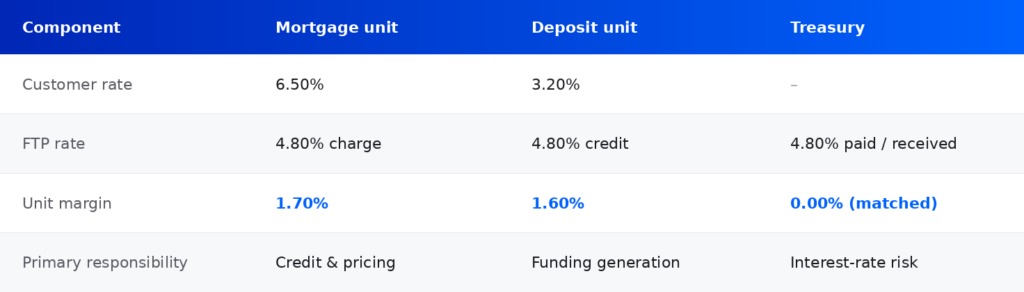
Assume a retail lending unit originates a five-year fixed-rate mortgage at a coupon rate of 6.50%.
Treasury’s five-year matched maturity FTP rate for this instrument is 4.80%. This rate reflects the bank’s five-year funding cost in the market, adjusted for a liquidity premium and a term premium.
The lending unit’s FTP-adjusted net interest margin is 6.50% minus 4.80%, which equals 1.70%. That 1.70% represents the unit’s pure credit and pricing contribution, isolated from duration risk and funding risk, which now sit with treasury.
Simultaneously, a retail deposit unit gathers five-year fixed-term deposits at a rate paid to customers of 3.20%.
Treasury credits those deposits at the same five-year matched maturity FTP rate of 4.80%. The deposit unit’s FTP-adjusted margin is 4.80% minus 3.20%, which equals 1.60%. That 1.60% is the deposit unit’s contribution for having gathered stable, term-matched funding.
Treasury’s net position: it charges 4.80% on assets and pays 4.80% on liabilities. Treasury nets to zero on matched instruments, having successfully transferred interest rate risk off the business unit P&Ls and onto its own books, where it can be managed centrally.
This is the fundamental purpose of FTP. When executed correctly, it creates clean, comparable economics at the unit level.
Funds Transfer Pricing Methodologies: Which Approach Is Right for Your Bank?
The methodology a bank selects has direct consequences for the accuracy of its profitability measurement and the precision of its interest rate risk allocation. Three approaches are used in practice, ranging from simple to sophisticated.
Single-Rate (Pool Rate) Method
The single-rate method applies one uniform FTP rate to all assets and all liabilities, regardless of maturity, product type, or instrument characteristics. The rate is typically derived from a short-term money market rate or the average cost of funds over the period.
This approach is operationally simple. It requires minimal data infrastructure and can be implemented without specialized technology. However, it introduces systematic mispricing when the balance sheet contains instruments of different maturities. A five-year fixed mortgage and a six-month revolving credit facility receive the same funding cost, which misrepresents both.
The single-rate method is generally appropriate only for banks with highly homogeneous balance sheets or as a starting point for institutions building toward a more mature methodology.
Multiple-Rate (Pooled Funds) Method
The multiple-rate method groups assets and liabilities into maturity or product buckets. Each bucket is assigned its own FTP rate, derived from rates appropriate to that bucket’s average tenor. Short-term assets receive one rate; long-term assets receive another.
This is a meaningful improvement over the single-rate approach. It captures the broad maturity structure of the balance sheet and avoids the worst cross-subsidies. However, within each bucket, all instruments still receive the same rate, regardless of specific contractual terms. A 48-month loan and a 60-month loan assigned to the same bucket receive the same funding cost.
The multiple-rate method is appropriate for mid-sized institutions with limited data infrastructure or for product types where granular matching is not economically material.
Matched Maturity (Marginal Cost) Method
The matched maturity method assigns an FTP rate to each individual instrument based on its specific maturity, repricing characteristics, and cash flow profile. Each loan or deposit is matched to an equivalent point on the bank’s funding curve. The FTP rate applied is the marginal cost of funding that specific instrument at the time of origination.
This is the methodology that accurately allocates interest rate risk to treasury and strips it from business unit margins. Because each instrument is matched to its own funding tenor, there is no cross-subsidization between short- and long-term products. Business unit managers cannot boost their margins by originating long-duration assets in a steep yield curve environment without treasury explicitly pricing that duration risk.
FTP Curve Defined
The FTP curve (also called the funds transfer pricing curve or internal transfer curve) is the bank-specific yield curve treasury constructs and maintains for use in matched maturity FTP. It represents the bank’s own marginal cost of raising funds at each maturity tenor, typically built from wholesale funding rates, swap rates, or a combination adjusted for the bank’s credit spread and liquidity conditions. The FTP curve is applied at origination for fixed-rate instruments and at each repricing date for variable-rate instruments.
The matched maturity method requires instrument-level balance sheet data, a well-maintained FTP curve, behavioral assumptions for non-maturity instruments, and technology infrastructure capable of running the calculations at the required volume and frequency. It is considered the industry standard for banks of substantive size.
Methodology Comparison
Dimension | Single-Rate | Multiple-Rate | Matched Maturity |
Complexity | Low | Medium | High |
Accuracy | Low | Medium | High |
Data requirements | Minimal | Moderate | Instrument-level balance sheet data |
Interest rate risk allocation | Approximate | Partial | Complete |
Best suited for | Small, homogeneous banks | Mid-size banks building capability | Large and complex financial institutions |
Yield curve required? | No | Partial | Yes, full FTP curve |
What Goes Into an FTP Rate? Key Components Explained
A matched maturity FTP rate is not simply the Treasury yield curve rate for the matching tenor. It is a composite rate built from several distinct components, each representing a real economic cost or risk that the bank bears when funding an asset or accepting a liability.
- Base rate. The risk-free rate at the matching tenor, typically derived from the swap curve, government securities, or overnight indexed swap rates. This represents the time value of money for the specific duration.
- Liquidity premium. The additional spread above the risk-free rate that the bank must pay to attract and retain stable funding in the market. This premium varies by tenor and market conditions and is distinct from the credit spread. During periods of market stress, the liquidity premium widens significantly.
- Term premium. The additional compensation lenders require for committing funds over a longer horizon. The term premium captures the structural cost of duration: longer-dated funding costs more than shorter-dated funding, independent of credit risk.
- Optionality adjustments. Many banking instruments contain embedded options. Fixed-rate mortgages carry prepayment options for the borrower. Lines of credit allow the borrower to draw and repay on demand. Non-maturity deposits may be withdrawn without notice. These options have economic value and impose a cost on the bank. Optionality adjustments add or subtract from the base FTP rate to reflect those embedded features.
- Liquidity contingency costs. Banks are required to hold liquidity buffers under regulatory frameworks such as LCR and NSFR. Maintaining those buffers has a cost, because high-quality liquid assets typically earn less than equivalent-duration earning assets. This cost is allocated through the FTP rate to the instruments that create the liquidity requirement.
Failure to model each of these components separately produces FTP rates that misallocate costs across business units. The most common omissions are the optionality adjustment and the liquidity contingency cost, both of which materially affect profitability measurement for retail banking and mortgage portfolios.
The Role of Treasury in Funds Transfer Pricing
Treasury is the functional owner of FTP in most bank structures. Its responsibilities encompass several distinct activities that span both model governance and balance sheet management.
Rate curve construction and maintenance. Treasury constructs and maintains the FTP curve that drives matched maturity calculations. This requires active market surveillance, regular updates to reflect changing funding conditions, and methodological discipline to ensure the curve is derived consistently over time. Rate curves that are allowed to drift or that are updated inconsistently introduce errors that accumulate in unit-level profitability reports.
Interest rate risk concentration. When FTP is functioning correctly, treasury absorbs the bank’s aggregate interest rate risk. Lending units are priced for the duration risk in their portfolios; deposit units are credited for the stability they provide. Treasury holds the net position and is accountable for managing it. This is treasury’s core economic function in the FTP framework.
Arbitrage prevention. Without central treasury ownership of FTP rates, business units have incentives to exploit maturity mismatches or rate differentials for their own reported margin benefit. A lending unit in a steep yield curve environment has every reason to originate long-duration assets if those assets are funded at a short-term pool rate. Treasury’s governance role is to prevent this by enforcing rate discipline and methodology consistency.
Performance attribution. Treasury itself is a profit center in a well-structured FTP model. Its margin comes from two sources: the spread it earns when it successfully manages interest rate risk (the residual between what it charges and what it pays after hedging), and any explicit charges it receives for providing liquidity services. These need to be tracked and reported separately from business unit performance.
Common Challenges in Implementing Funds Transfer Pricing
Data Quality and Balance Sheet Granularity
Matched maturity FTP requires instrument-level data. For each asset and liability, the model needs the contractual maturity or repricing date, the outstanding balance, the coupon or rate, and the origination date. For large retail banks, this means processing data across millions of individual accounts.
Most banks’ core banking systems can produce this data, but the pipeline from transaction systems to FTP calculation often introduces inconsistencies. Accounts with missing maturity data, instruments classified at the product level rather than the instrument level, and lag between transaction booking and data availability all degrade FTP accuracy.
Data governance for FTP is not primarily a technology problem. It is an organizational discipline problem. Banks that invest in clean data pipelines before implementing matched maturity FTP avoid months of model reconciliation after go-live.
Yield Curve Construction and Maintenance
The FTP curve must be actively maintained. A curve that reflects the bank’s funding cost accurately in January may be meaningfully off by March if market conditions shift or if the bank’s credit spread changes.
Banks face two practical decisions: how frequently to update the FTP curve, and how to handle instruments originated under different rate environments. Origination-date locking, where each instrument retains the FTP rate applied at origination, is the standard approach for fixed-rate instruments. Variable-rate instruments update at each repricing date. Managing this distinction requires methodology clarity and tooling that can track both the current FTP rate and the origination-date rate for each instrument.
Behavioral Assumptions for Non-Maturity Instruments
Non-maturity deposits, primarily demand deposits and savings accounts, have no contractual maturity. They can be withdrawn by customers on demand. In practice, these balances exhibit stable, long-duration behavior at the aggregate level. Core deposits at most retail banks turn over far more slowly than their legal terms suggest.
The behavioral maturity assumption, which estimates the effective duration of the stable portion of these deposits, is one of the most consequential inputs in an FTP model. If a bank assigns demand deposits a 30-day behavioral maturity, those deposits receive a low FTP credit. If the bank assigns a 24-month behavioral maturity based on historical runoff analysis, the deposit franchise’s contribution rises substantially.
These assumptions require historical data analysis, periodic validation, and formal documentation. They are subject to governance review precisely because they are consequential and subject to management judgment.
Governance, Transparency, and Business Unit Buy-In
FTP rates affect business unit performance metrics directly. A methodology change that increases the FTP charge on a product category can reduce a lending unit’s reported margin by tens of basis points, with direct consequences for business unit budgets and compensation. Business units have strong incentives to challenge FTP methodology when it is unfavorable to them.
Governance frameworks that are clear about who owns the methodology, how rates are derived, and what the process is for reviewing challenges protect the integrity of the FTP system. When business units cannot trace an FTP charge back to its source inputs and methodology logic, disputes become unresolvable and confidence in the numbers erodes.
Transparency is not a preference. It is a structural requirement for FTP to function as a management tool.
The politics of FTP are not incidental to this. When a methodology change reduces a business unit’s reported margin by 20 or 30 basis points, the business unit head does not accept that passively. Finance leaders who have redesigned FTP frameworks will recognize the pattern: the most technically correct methodology change is almost always the most politically difficult to implement. Governance that defines who owns the methodology and how business unit challenges are resolved must be in place before the first rate change, not assembled under pressure after it.
Funds Transfer Pricing and Bank Profitability Analysis
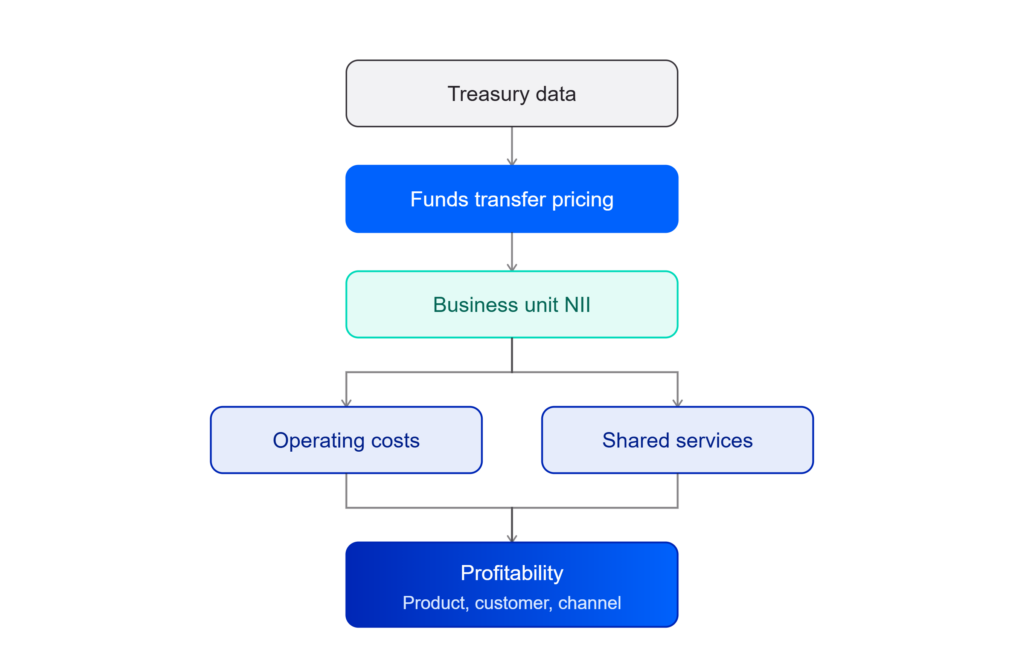
FTP-adjusted net interest income is the foundation of business unit profitability, but it is not the complete picture. After FTP charges and credits have been applied, a lending unit’s P&L still carries its share of operating costs: staff, technology, compliance, shared service centers, and corporate overhead. Without those allocations, what appears to be a high-margin business line may be consuming disproportionate resources that never appear in the unit’s reported economics.
This is where FTP integration with cost allocation becomes analytically critical. A bank that runs FTP in one system, allocates operating costs in another, and reconciles them in a spreadsheet is working with numbers that are always slightly wrong and always slightly late. The reconciliation cycle consumes time, and the manual handoffs introduce error that compounds at each reporting period.
CostPerform is an enterprise cost allocation software used by banks to integrate FTP data from treasury with operating cost allocation across business units, generating granular profitability reports at the product, customer, and channel level. More than 150 major financial institutions use CostPerform, including ING, KBC, Belfius, and the National Bank of Belgium.
The practical implication for finance leaders is this: FTP accuracy without cost allocation accuracy still produces incomplete profitability data. The two functions should be integrated in the same governed model, maintained by the same finance team, on the same data infrastructure. Separating them creates reconciliation overhead and degrades the quality of the output that business unit leaders, the CFO, and the board rely on to make decisions.
CostPerform supports Activity-Based Costing, Time-Driven Activity-Based Costing, and multidimensional costing, using FTP data from treasury as an input alongside GL and shared service costs, with direct integrations to SAP, Oracle, NetSuite, and Microsoft Dynamics, and BI output to Tableau, Power BI, and QlikSense.
How to Implement Funds Transfer Pricing: A Step-by-Step Overview
FTP implementation is a structured project. The following sequence reflects the order in which dependencies arise and is applicable to banks building a new FTP framework or migrating from a pool rate to a matched maturity methodology.
- Define the governance structure. Before any methodology is designed, the organization needs clarity on who owns FTP. Treasury typically owns rate curve construction and methodology. Finance owns validation and reporting. Business units have defined escalation paths for challenging outputs. Document this before model design begins.
- Assess data availability and quality. Map the data elements required for matched maturity FTP, instrument-level balance, maturity date, repricing date, coupon, origination date, to the actual availability of that data in your core banking and GL systems. Identify gaps early. Data remediation is the most common cause of implementation delays.
- Select the methodology for each product category. Not every product type needs matched maturity treatment on day one. Define which products will be matched maturity from the start, which will use pooled rates initially, and what the roadmap is for migration. Document the rationale.
- Construct the initial FTP curve. Build the bank’s internal funding curve from wholesale funding rates, swap rates, or a composite, adjusted for the bank’s credit spread, liquidity premium, and term premium at each tenor. Define the update frequency and the process for maintaining the curve going forward.
- Define behavioral assumptions for non-maturity instruments. For demand deposits, savings accounts, and committed lines, develop behavioral maturity assumptions based on historical runoff analysis. Document the methodology and establish a review cycle.
- Configure the FTP calculation engine. Implement the FTP model in a platform that can process instrument-level data at the required volume, apply the correct methodology by product type, track origination-date rates for fixed instruments, and maintain a full audit trail. Validate outputs against manual calculations for a representative sample before going live.
- Integrate with cost allocation and reporting. Connect FTP output to the cost allocation model so that business unit P&Ls reflect both FTP-adjusted NII and allocated operating costs in a single governed environment. Establish the reporting hierarchy: product, customer, branch, business unit, segment.
- Establish ongoing governance and validation. Schedule regular validation of FTP outputs against realized funding costs. Define the process for methodology changes, including documentation, approval, and communication to business units. Build the audit trail capability needed for internal governance and regulatory review.
Frequently Asked Questions
What is the difference between funds transfer pricing and transfer pricing?
The difference between funds transfer pricing and transfer pricing is that transfer pricing, in the general corporate sense, refers to the prices set for transactions between related legal entities, typically for tax purposes. Funds transfer pricing is specific to banks and financial institutions. It is the mechanism for pricing the internal flow of funds between business units within a single legal entity or group. FTP has no direct tax purpose; its purpose is management accounting accuracy and interest rate risk attribution.
Why is matched maturity FTP considered the gold standard?
Matched maturity FTP is considered the gold standard because matched maturity FTP is the only methodology that completely isolates interest rate risk in treasury. When every asset and liability is funded at its specific maturity tenor, business unit margins reflect only credit spread and pricing discipline, with no contamination from duration mismatches. Other methodologies allow cross-subsidization between long- and short-duration products, which distorts profitability reporting and creates pricing incentives that do not reflect the bank’s actual economics.
How often should FTP rates be updated?
FTP rates should be updated according to the type of instrument. For fixed-rate instruments, the FTP rate is typically locked at origination and held for the life of the instrument. For variable-rate instruments, the rate is updated at each contractual repricing date. The FTP curve itself should be reviewed monthly at minimum, with intra-month updates when market conditions shift materially. Behavioral maturity assumptions should be validated at least annually against observed deposit behavior.
Can FTP be implemented in a spreadsheet?
FTP can be implemented in a spreadsheet in certain circumstances. A basic single-rate or two-bucket FTP model can be implemented in a spreadsheet for small, simple balance sheets. Matched maturity FTP at any meaningful scale cannot. The combination of instrument-level data volumes, curve management, version control requirements, audit trail obligations, and scenario modeling capability exceeds what spreadsheet environments can provide reliably. Banks that run FTP in spreadsheets typically face the same problems: inconsistent methodology application across periods, no audit trail connecting outputs to inputs, and an inability to model rate scenarios quickly.
How does FTP relate to net interest margin?
FTP relates to net interest margin in that FTP disaggregates the bank-wide net interest margin into unit-level contributions. At the aggregate level, the sum of all FTP charges and credits nets to zero within treasury: every charge paid by a lending unit corresponds to a credit paid to a liability unit or held by treasury. The bank’s NIM is the sum of business unit FTP-adjusted margins plus treasury’s own contribution from managing the residual interest rate risk. FTP does not change NIM; it allocates NIM to the business units responsible for generating it.
How do non-maturity deposits affect funds transfer pricing in banking?
Non-maturity deposits affect funds transfer pricing in banking because they have no contractual maturity but often exhibit stable, long-duration behavior at the aggregate level. The behavioral maturity assumption, which estimates the effective duration of the stable portion of these deposits, is one of the most consequential inputs in an FTP model. If a bank assigns demand deposits a short behavioral maturity, those deposits receive a lower FTP credit. If the bank assigns a longer behavioral maturity based on historical runoff analysis, the deposit franchise’s contribution increases substantially. These assumptions require historical data analysis, periodic validation, and formal documentation.
See How CostPerform Uses FTP to Drive Bank Profitability
CostPerform’s banking team works with CFOs, treasury managers, and finance controllers to demonstrate how FTP data from treasury integrates with cost allocation and profitability reporting within a single governed platform. A banking demo covers live cost model configuration, FTP data integration, and the connection from FTP input to product and customer profitability reporting.