



What can CostPerform do for you?
Your cloud & AI spend, in one governed view.
Trace every cost from the general ledger to the product.
Planning ahead with What-If Analysis.
Your Financial and Operational Data, ready for decision-making.
Get a grip on managing costs and profitability.
From rate-based ABC to direct costing, which method is right for your organization?
An accurate way of assigning indirect costs to products and services.
Activity based costing, while taking into account how much time a process step takes.
Our models allow you to go down to the most granular level: the individual sales transaction.
BRITISH TELECOM
Discover British Telecom’s use of the TBM framework for intricate regulatory reporting calculations, achieving precise outcomes within mere minutes
Continue reading
TEXAS CAPITAL BANK
How Texas Capital Bank, a leading US bank, reimagined their approach to banking profitability and made it futureproof for the years to come
Continue reading
Over 23 years of costing experience across the globe.
Boost your clients’ success and grow your revenue.
Join our team and assist organizations to thrive.
We are ready to answer all your questions about cost and performance.
See how cost allocation software compares with Excel on seven capabilities, from deeper granularity to traceable allocations and faster scenario analysis, and what that means for the
CostPerform & Armada are tackling bank cost optimization together.
Find the resources you need for your cost and performance management.
Read all the news and blogs about the industry and CostPerform.
See who we’ve helped before and how we could be a good fit to your organization.
Alexandria, US | 2 November, 2026
Registration is now closed. Check out the agenda and keep an eye on your email for the latest updates!
Online | 12 November, 2026
A practical discussion on AI, profitability analytics, decision intelligence, and what it really takes to make AI defensible in banking.
Online | 17 November, 2026
A customer-only webinar showing how Carlos, the new AI assistant in CostPerform 2026.1, answers questions, builds ETL chains, and writes scripts.
Learn how to model your costs and profitability.
How does De Pindakaaswinkel (The Peanut Butter Store) steer true profitability across channels while protecting margins and preserving a brand built on taste, sustainability, and inclusivity?
Protect margin while scaling a specialty retail flywheel across stores, pop-ups, e-commerce, and B2B, so leadership can act early on margin leakage, even when high revenue looks healthy when store or product economics are declining.
One integrated, multi-dimensional profitability model that applies the same financial logic to reveal margin performance per channel, product, peanut butter flavor, and location.
Early visibility into unprofitable stores and products, improved margin control across channels, and a fact-based foundation for sustainable growth in specialty retail.
Started in Michiel Vos’ kitchen table in 2014 with a simple ambition: to make the world’s tastiest, most sustainable peanut butter. It quickly grew into a global specialty brand with 11 stores, pop-ups, online, and B2B sales.
It’s not just a playful identity with unconventional flavors, it’s also a mission driven enterprise – using 88% peanuts from high-wage, no-tillage farms in Argentina, palm oil-free and protein-rich. That same care extends to hiring people from all psychological backgrounds and partnering with schools to run student-led stores, all without compromising on quality.
With no funding and supermarket shelf space, De Pindakaaswinkel has proven balancing mission with margin in an omnichannel environment is possible.
Still high-street rents, rising wages, inflation, and raw material costs put constant pressure on the business. For years, Michiel only looked in to the current account and went by instinct. As he puts it: Retail is a beautiful but brutal game. Growth only works if costs stay under control and chose to turn to fact-based cost steering.
Michiel Vos, Founder and CEO
De Pindakaaswinkel
Primary challenge:
How can De Pindakaaswinkel steer profitability across stores, online, and B2B when the same jar carries materially different cost-to-serve burdens by channel and location?
Revenue was visible, but the full cost picture was fragmented. Store economics depended on rent, building costs, and personnel. Online economics depended on marketing and fulfillment. Without an integrated view, leadership could not see where value was created, and where margin quietly leaked. Decision-making was defaulted to instinct.
The team learned that best sellers were not always best earners. Jars were roughly similar to produce, yet profitability varied sharply by flavor and sales route. Some high-revenue stores looked successful until location-level cost allocation revealed margin pressure. A strong location could be margin negative. In several cases, unprofitability became clear too late and the decision window had passed.
Retail volatility, wage pressure, and prime-location rent dynamics made late insight expensive. In some cases, stores were recognized as unprofitable only after the decision window had passed, increasing the cost of correction.
De Pindakaaswinkel with CostPerform to apply one multi-dimensional model with the same financial logic across stores, Shopify, and B2B, while still reflecting channel-specific cost drivers. Teams could compare performance fairly and see where value was created.
Profitability became visible at the level where retail decisions are made. The model showed that similar production costs can still create different margins once channel and location burdens are applied. The same product could be financially strong in one channel and weak in another. Eg. Same jar, same price, different unit cost by store. It also highlighted when a popular flavor carried higher cost but insufficient margin, to justify its sales mix without adjustment.
CostPerform mapped profitability by store, proving that high revenue can still underperform on margin once rent and personnel are correctly allocated. Insights were operationalized in a Power BI dashboard built for ongoing steering, giving leadership visibility into store-level margin outcomes, channel performance, and geographic customer demand patterns.
Shift from reporting to steering power: This turned profitability into a daily management instrument, enabling earlier interventions, renegotiation triggers, and clearer network pruning decisions tied to margin and growth priorities.
A single profitability view that connects channel, product, flavor, and location economics using consistent allocation logic.
Leaders can now compare performance with confidence and steer decisions with evidence.
De Pindakaaswinkel aligned store, online, and B2B economics into one profitability view, enabling like-for-like performance comparison across locations, products, and flavors.
Management can see where margin drops, understand what drives it, and act on staffing, rent burden, pricing, or assortment before losses build up.
CostPerform helped turn a specialty brand into repeatable profit control, giving large retailers a clear way to improve omnichannel margins without slowing innovation.
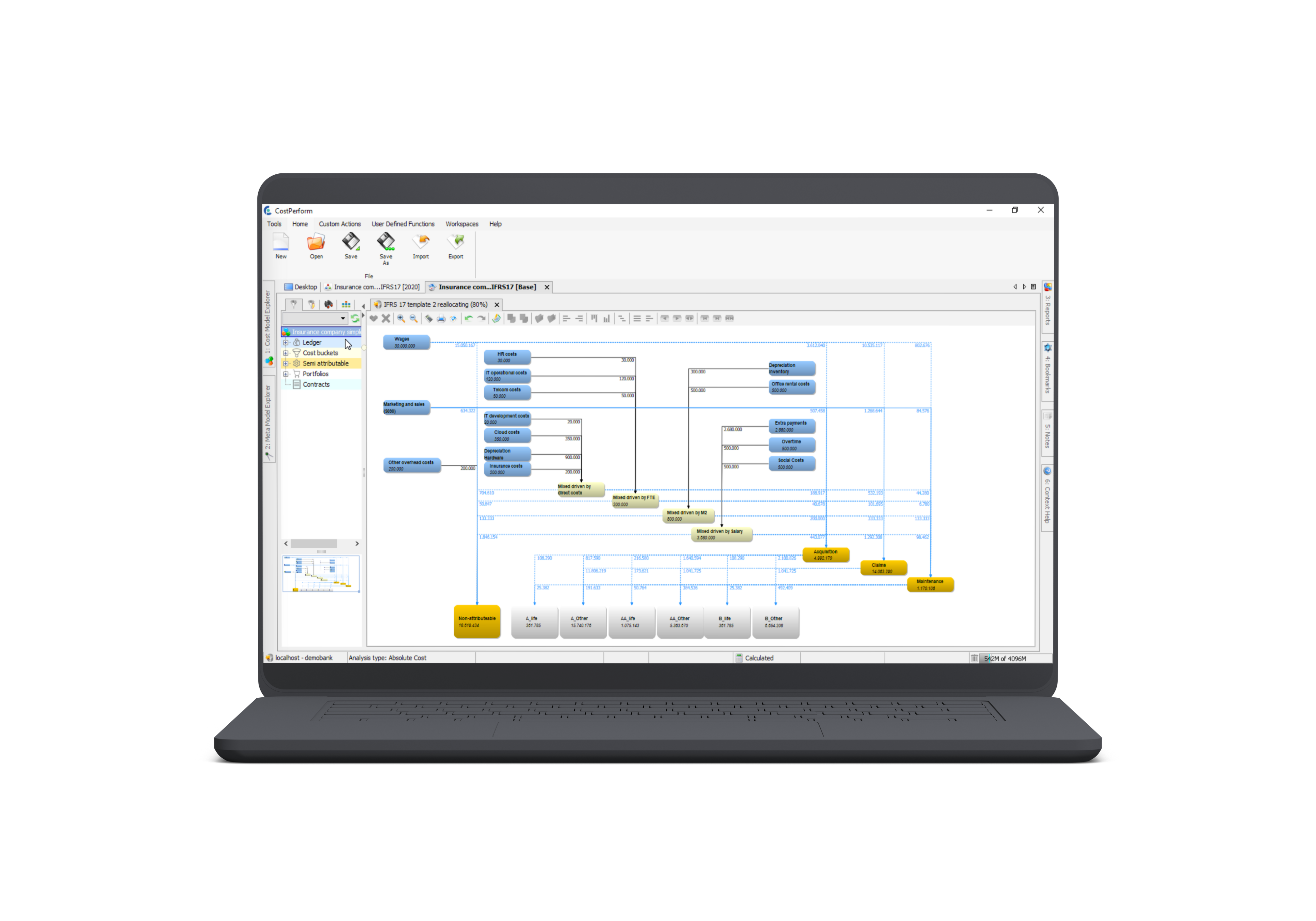
Crafted over 20+ years by econometrists and cost experts, CostPerform is the solution for defining, designing and maintaining your cost and profitability model. Any mathematical approach of cost allocation you can think of, is possible.
From insurance companies and merchant banks to central banks: CostPerform is used by financial institutions to determine profitability, report to regulators and to simulate future business models.
Contact us today to get insights into which products, customers, channels or transactions make you the most money, by allocating the associated costs.